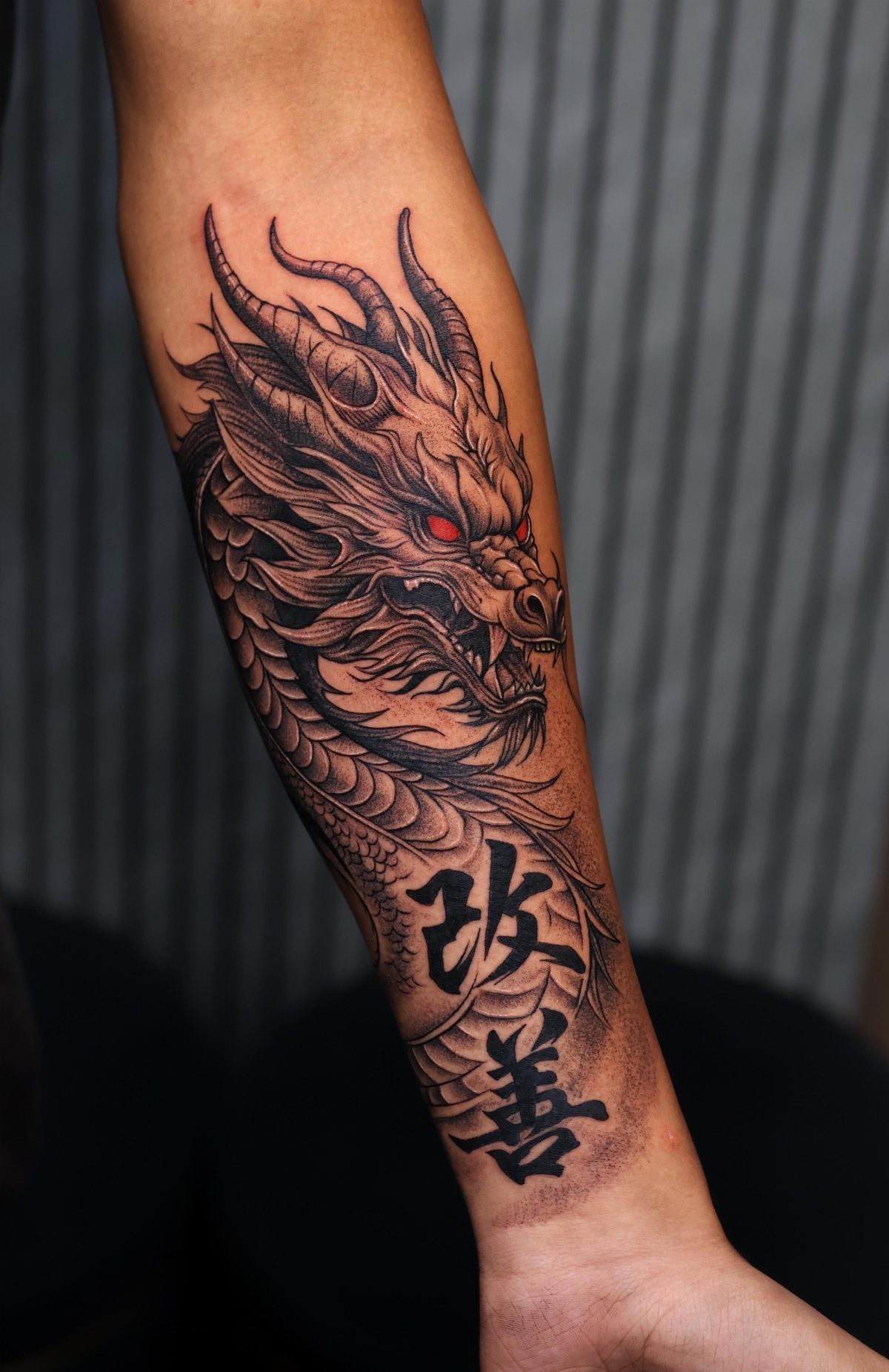
A single session of black line art or years of full-back color, the range is wide, and the real question is how much skin you are ready to commit.
A dragon needs room to move; pin it to a straight line and you get a snake with legs glued on.
The wrap has to be mapped on skin, not paper, because a back or a rib cage curves and the stencil does not.
1. Japanese Dragon

A Japanese dragon tattoo wraps the body like smoke around a flame, following muscle lines instead of fighting them.
The long, wingless shape needs space to turn; chest to shoulder or hip to knee lets the coils breathe. Blue, green, gold, and black are the usual palette, with wind bars or clouds filling gaps between scales.
I would put this where the body moves, since the design lives in motion. The style rewards patience and a budget that covers multiple sessions; rushing the wrap-around loses the flow that makes it work.

COMPLETE TATTOO STARTER KIT WITH THERMAL STENCIL PRINTER: The Dragonhawk A1 Pro bundles everything a beginner needs into one package — a rotary pen machine, the M6 thermal stencil printer for transferring designs, 20 cartridge needles (10x 1203RL round liner, 10x 1205RS round shader), black tattoo ink, practice skin, and essential accessories including grips and transfer paper. The integrated M6 printer is what sets this kit apart from standard tattoo kits that require a separate stencil transfer tool, giving new artists a complete workflow from design to practice without additional purchases.
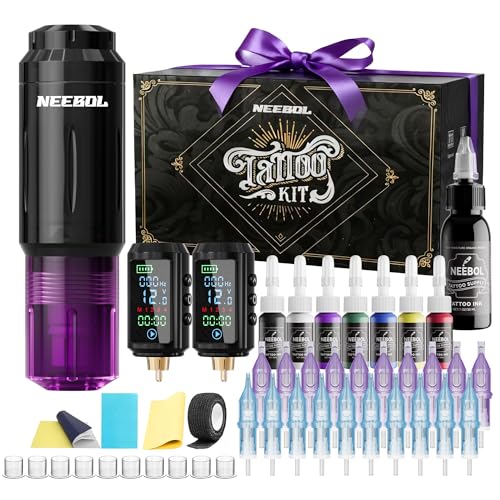
NEEBOL Tattoo Machine Kit with Complete Accessories:This tattoo machine kit includes 1 wireless tattoo gun, 2 x 1600mAh batteries, 20 needles, a large bottle off black ink, a full color ink set, and other essentials—ideal for beginners, apprentices, and professionals seeking a maquina para tatuar.

【Complete All-in-One Tattoo Starter Kit】This set includes the Dragonhawk A3 Pro wireless tattoo machine, an A4 thermal stencil printer, 20 cartridge needles (10x 1203RL for lining + 10x 1205RS for shading), 0.5oz black tattoo ink, 6 transfer papers, 1 practice skin, 1 pair of gloves, 1 grip cover, and an RCA adapter for corded use. You can open the box and start practicing — no additional supplies needed.
2. Chinese Dragon
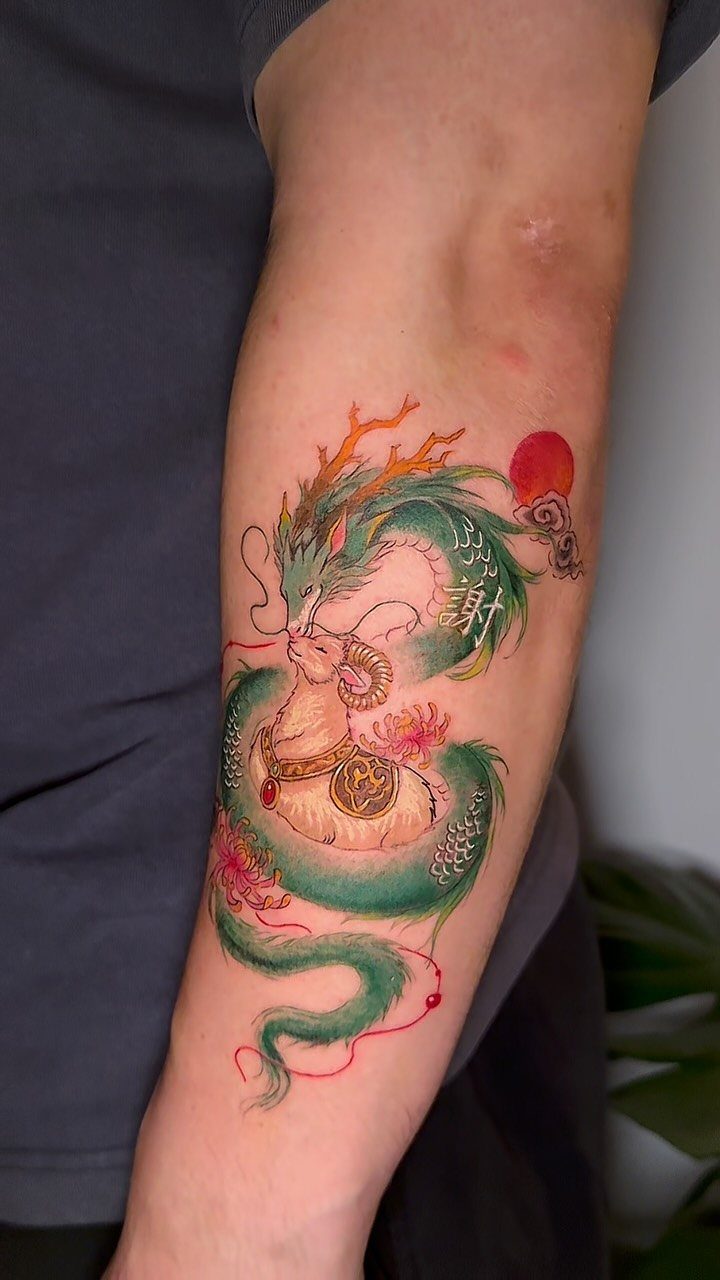
Chinese dragons carry a pearl, usually flaming, that marks them from their Japanese cousins.
The coils run tighter and more ornate, with horns and whiskers worked in finer detail than the broader strokes of irezumi. Power and good fortune are the meanings people ask for, though the pearl itself stands for wisdom.
A forearm can hold a smaller coiled version, but the full effect needs more room; the body of the dragon wants to stack and turn rather than stretch straight.
Green and gold read traditional, though I have seen red suns and flower fills that pull the eye without cluttering the line.


3. Western Dragon
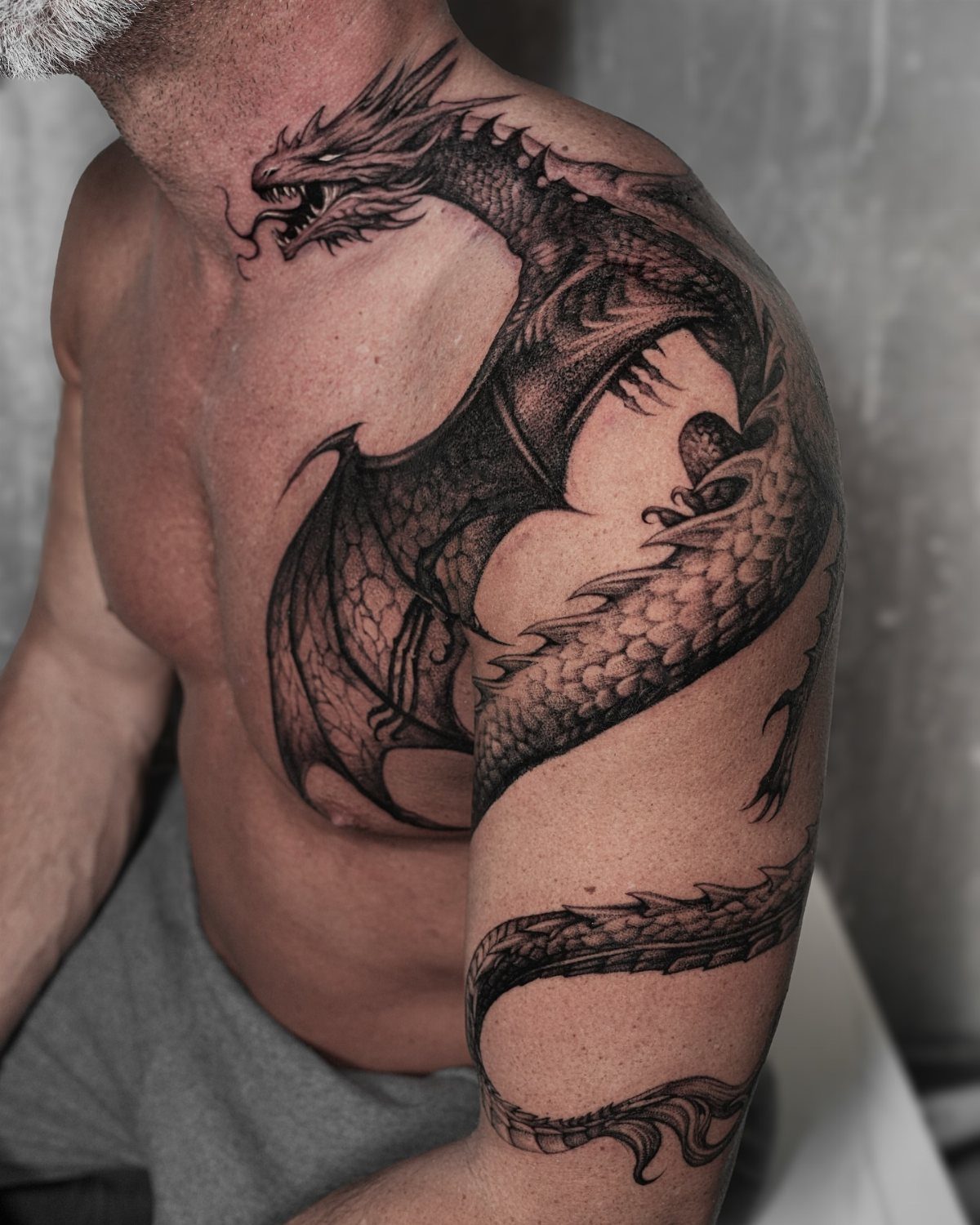
Western dragons land harder than Eastern ones: bat wings, armored scales, and a stance that looks ready to claw.
The style grew out of medieval heraldry and fantasy illustration, so blackwork or neo-traditional handling suits it better than the flowing color of Asian traditions. A neck-to-chest-to-arm placement lets the wings spread across the slope of the shoulder.
This is the choice when you want aggression rather than grace. The scales take time to build in layers; a single session gives you outline and basic fill, but the depth that makes it read as armor comes later.

【Wild Animal Stencils】7 Animal Templates: Tiger, Lion,Panda,Wolf,Dragon, Pterosaur Patterns, different animal template can decorate your farmhouse or home.Great gift for DIY craft projects

🐟Chinese Style: the art template stencil set features various Chinese Style pattern design Fu Zodiac Great Wall Panda Fish Taiji etc , easy to bring you chinese element atmosphere, ideal for drawing tracing, house embellishment, making a pretty addition to your home.

Material: Made from durable plastic material , reusable and easy to operate.
4. Tribal Dragon
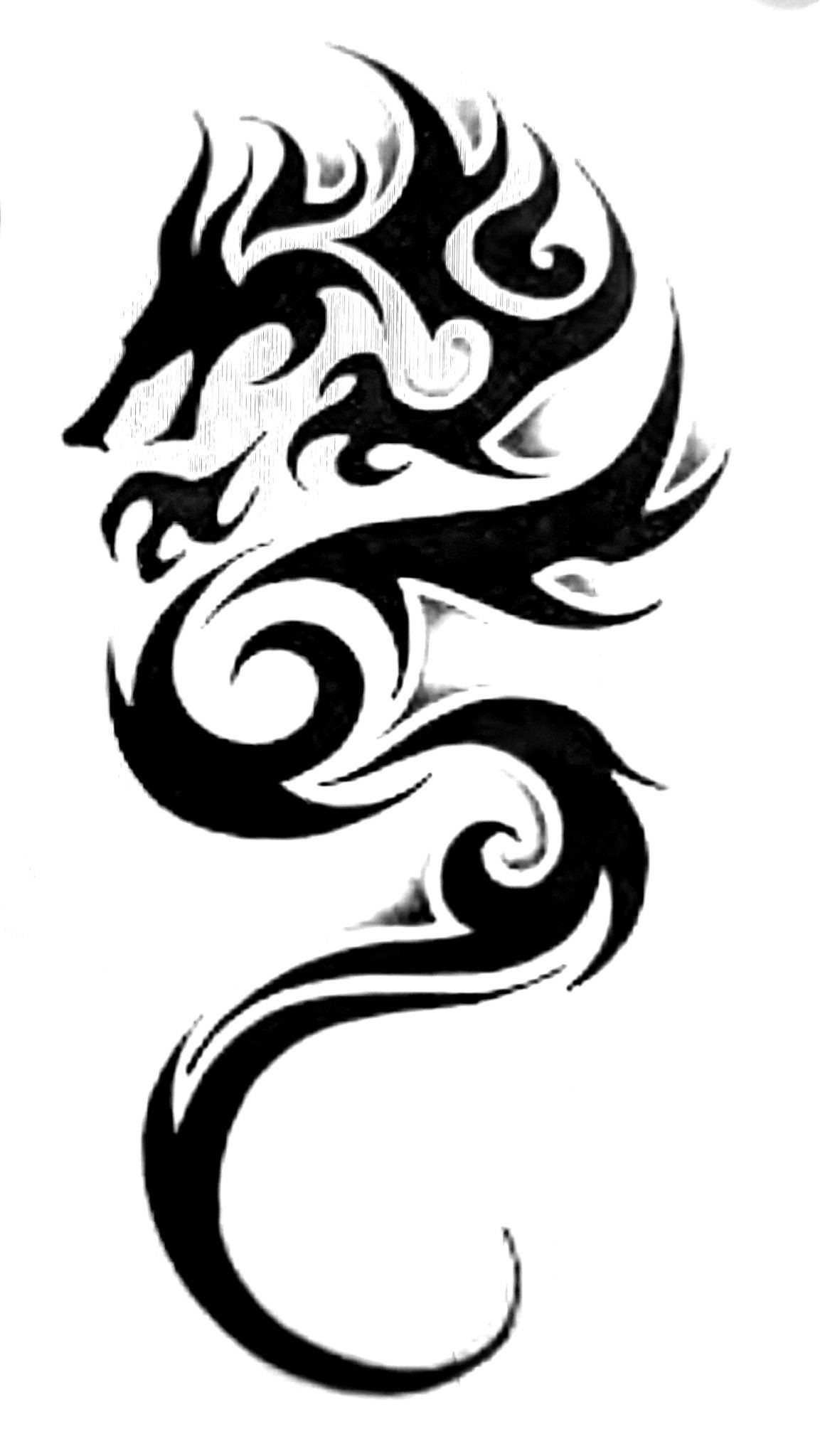
Tribal dragon work drops the scales and keeps the silhouette: solid black, flame-shaped points, curves that read as motion without showing motion directly.
The style lives on shoulders and upper arms, where the swirl can follow the round of the muscle or wrap flat against the blade.
It is the budget move that still reads bold from across a room.
No color means fewer sessions and less maintenance as the ink ages; the trade is that detail fades into abstraction, and the dragon becomes a shape you recognize rather than a creature you study.

Dragon Silhouette Stencil: You will receive 4 pieces of painting stencils which have small beautiful animal theme patterns. There are 42 kinds of dragon silhouettes patterns on the stencils. Our templates are suitable for you to make decoration by yourself. Please note: This product is intended for ages 14 and above.

Variety of Dragon Designs and Sizes: This set includes 30 intricately designed PET stencils featuring different dragon motifs, with 10 pieces measuring 11.81×2.99 inches, 10 pieces at 5.91×5.91 inches, and 10 pieces at 2.99×2.99 inches, offering versatile options for your projects

Dragon Themed Design: The dragon stretches its wings and stands at the top of the mountains. With the embellishment of stars, moon, and mountains, it adds a fairy tale atmosphere, suitable for use in bookkeeping, decorative painting, DIY cultural and creative projects, etc.
5. Full Sleeve
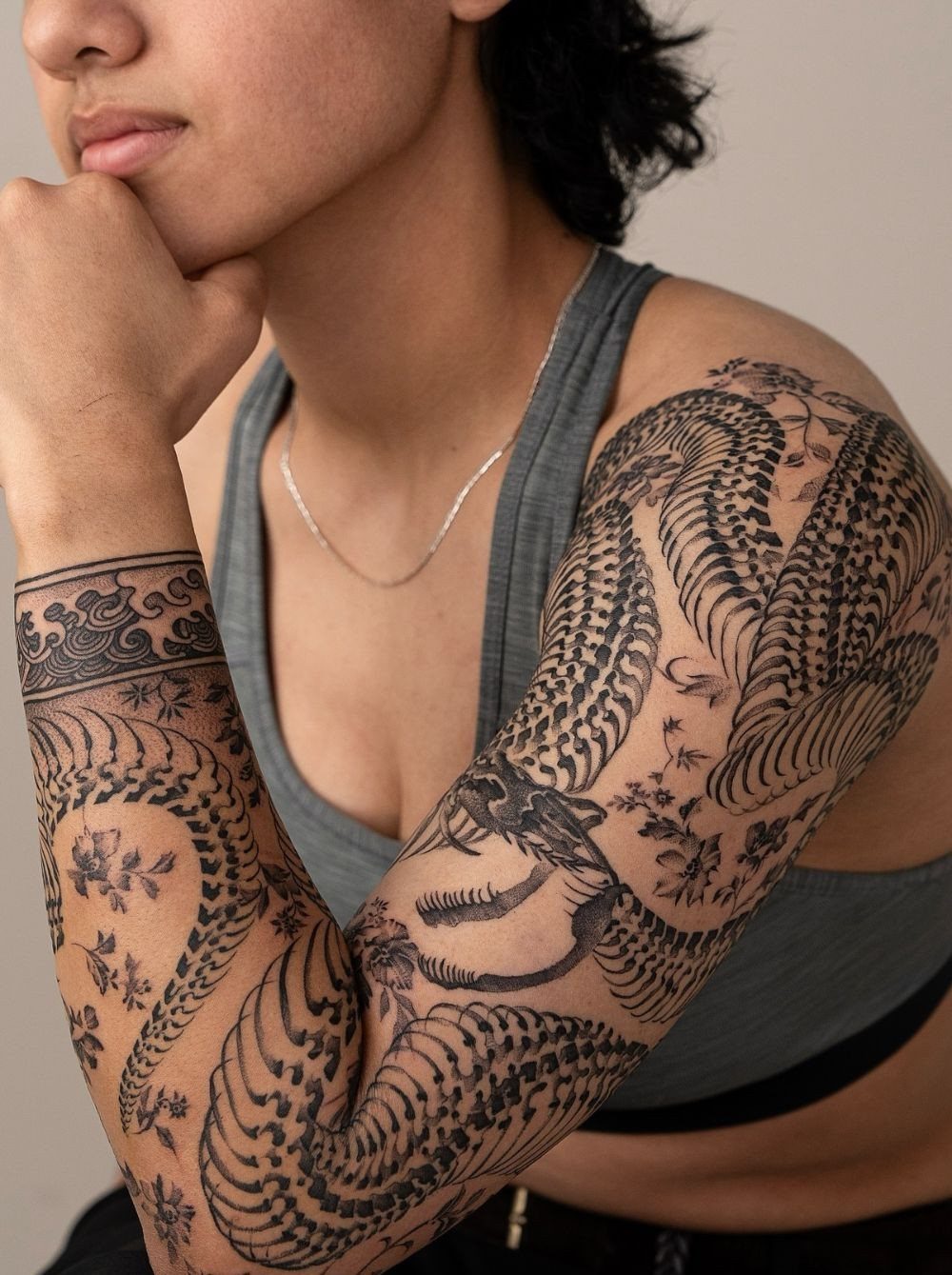
A dragon’s body is built to wrap, so the full sleeve is less a choice than a natural fit.
Japanese styling dominates here because the elongated form needs the length; the head can sit at the shoulder, the tail coil past the wrist, with wind, waves, or cherry blossom filling the gaps.
The arm moves, and the tattoo moves with it. Multiple sessions are standard, and the design must be planned before the first line goes in, since the wrap has to read from every angle.
I would check that my artist has done sleeves, not just large pieces, since the cylinder of the arm is its own problem.

VARIETY PACK: Set includes 12 unique tribal dragon designs in bold black ink, offering diverse artistic styles from fierce to elegant interpretations

32 Bold Animal Tribal Patterns – 4 large A4 sheets featuring Dragons, Wolves, Scorpions, Lions, and more, for a strong, edgy look with professional-quality stencils.

🐳[8 Sheets Black Dragon Tattoos in One Package!] - Original Brand of TASROI 3D imperial loong Tribal Dragon Temporary Tattoos For Women Men and Adults. Tattoos Temporary Contains 8 Large Sheets Water Transfer Animals Dragon Floral Flower Rose Moon Serpent Totem Armband Etc.
6. Full Back
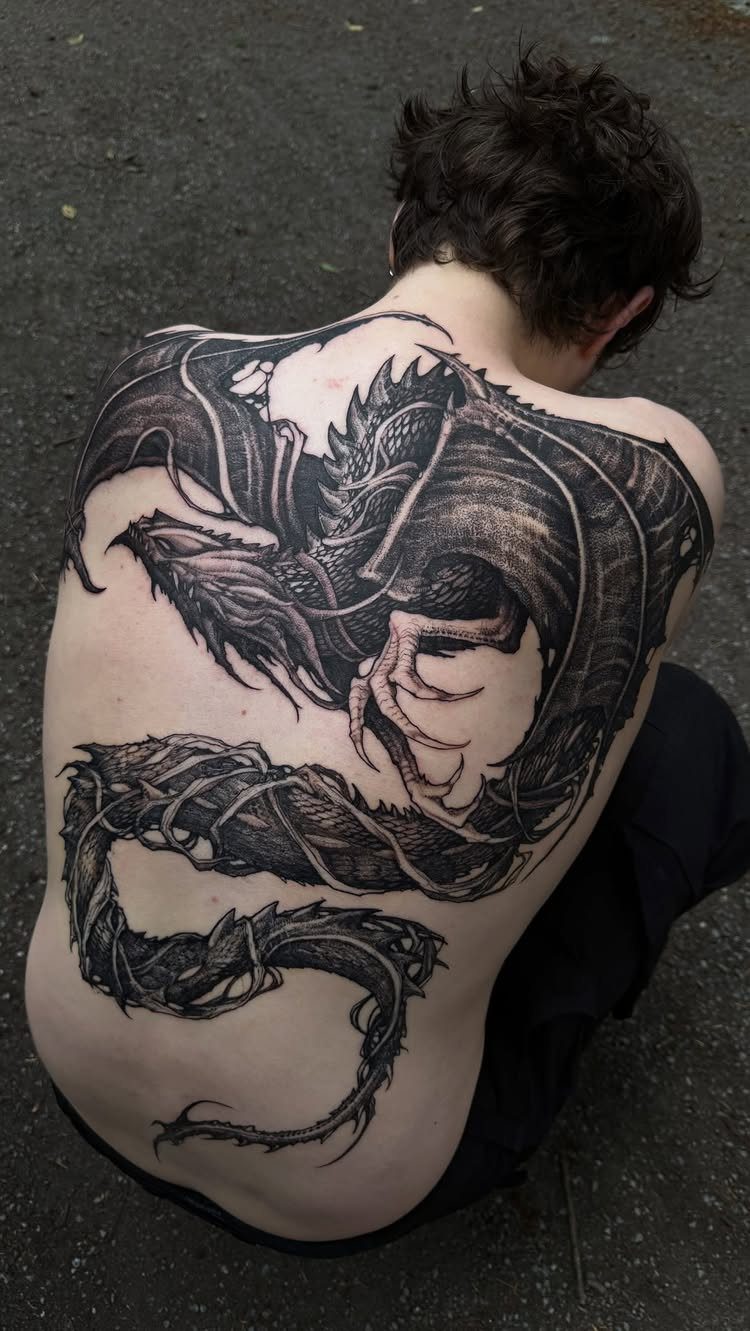
The back is the only canvas large enough for a dragon to live at full scale, and Japanese irezumi tradition recognized this first.
A full-back piece is a commitment measured in years and in sittings that test what you can take; the result is not a decoration but a statement that you belong to the work.
The dragon can climb, descend, or coil across the shoulder blades with the tail reaching the waist. Color or black-and-grey both work; the room to build texture in the scales and the background decides it.

Delicate design: You will receive 11pcs mermaid scale stencils, include big large 8pcs 6x8 inch mermaid stencils, small mimi 7x3.75 inch, 5.5x2.9 inch and 4.7x3.1 inch face body paint stencils and a organize storage ring, different sizes of fish scales for your daily need,make your face and art projects more attractive.

COMPLETE FACE PAINTING KIT: This all-in-one Face Paint Stencil Kit from Yazhiji is your essential set of face painting supplies. It includes 36 reusable Face Painting Templates, 6 sheets of tattoo stencil stickers, 10 Face Paint Brushes, 2 packs of Sticky Gems for Face, and 4 sponges. Get everything needed for creative body paint projects and kids face painting, making it the ideal Party Makeup Kit for any event.

7. Chest and Rib
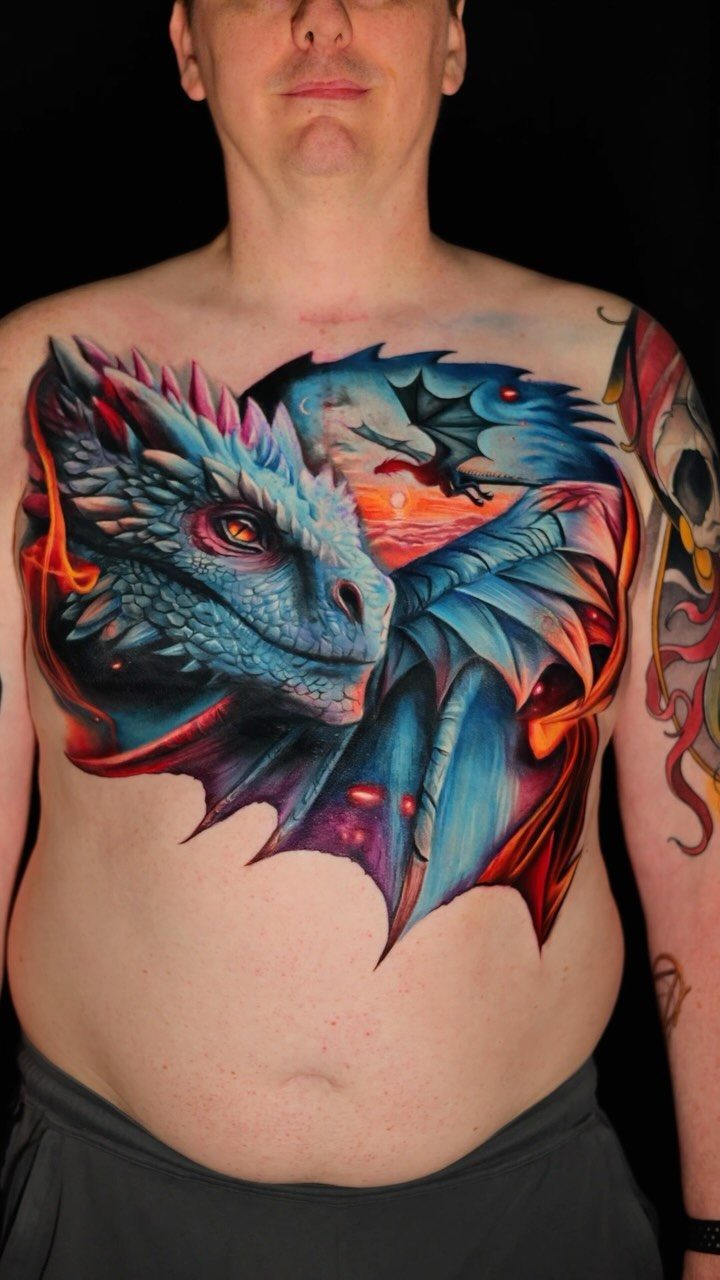
A chest and rib dragon lives in the stretch and contract of breathing, so the coil has to be planned around motion.
A chest dragon starts at the sternum and anchors on the pectoral, then sends the tail across the upper ribs where the skin does not stretch as much.
I would keep the head central, where the eye lands first, and let the body wrap toward the arm or descend the side. Color holds well here; the chest sees less sun than the forearm, so the saturation lasts.
The trade is the pain around the sternum and floating ribs, which is sharp and sustained. This placement suits someone who wants impact without committing the full back or both arms.


8. Forearm
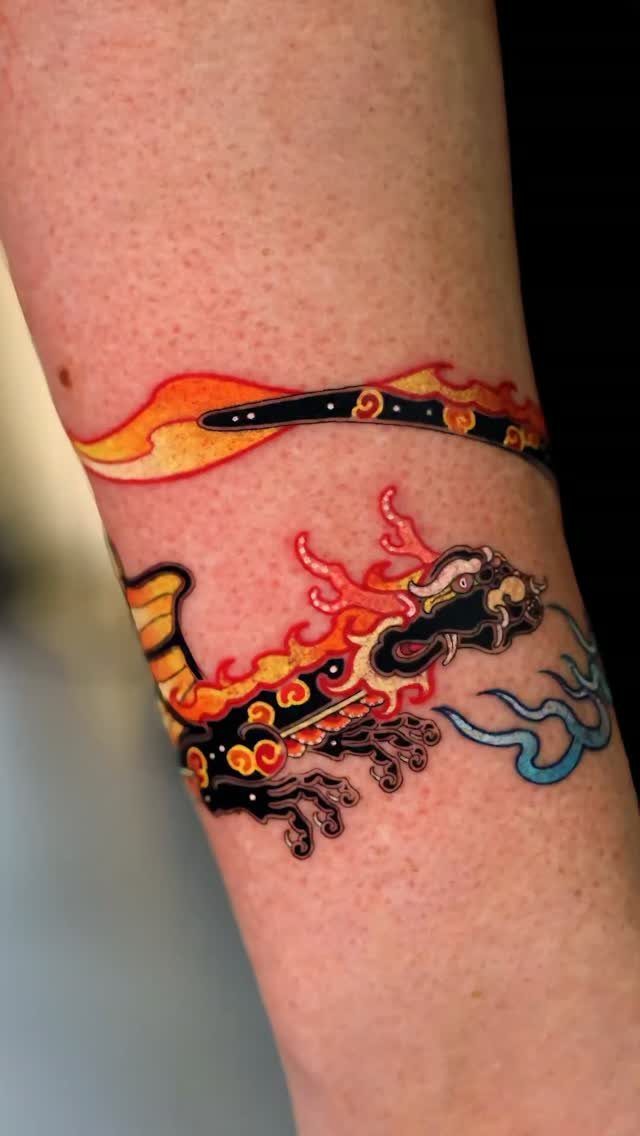
The forearm is where a dragon becomes jewelry: visible, readable, and finished in fewer sessions than a sleeve. A coiled body or single head works here because the space is narrow and the viewer is close.
I like this for a first large piece or for someone whose work keeps the back and chest covered.
The wrist and elbow are the hard points; the artist has to simplify the line through those spots or let the design break and restart.
A dragon head facing the hand reads as guardian, one facing the heart reads as personal. Either way, the forearm is a statement you choose when to show.

Hollow Out Stencil: You will receive a total of 9 pieces of craft stencils with different designs for each piece, enough quantity can meet your daily DIY and decoration needs. Sizes and details are as follows: Painting Stencils1: about 11.8 inch/30cm wide, 11.8 inch/30cm long, 3 styles, 1pc/style, 3pcs; Painting Stencils2: about 8.27inch/21cm wide, 11.69inch/29.7cm long, 6 styles, 1pc/style, 6pcs.

Chinese Dragon Design: Features a detailed and intricate Chinese dragon motif, perfect for Asian-inspired, fantasy, and mythical projects.

Package Comes with: you will receive 1 piece reusable painting stencil, which is A4 size 8.3 x 11.7 inches / 21 x 29.7 cm
9. Ideal Placement
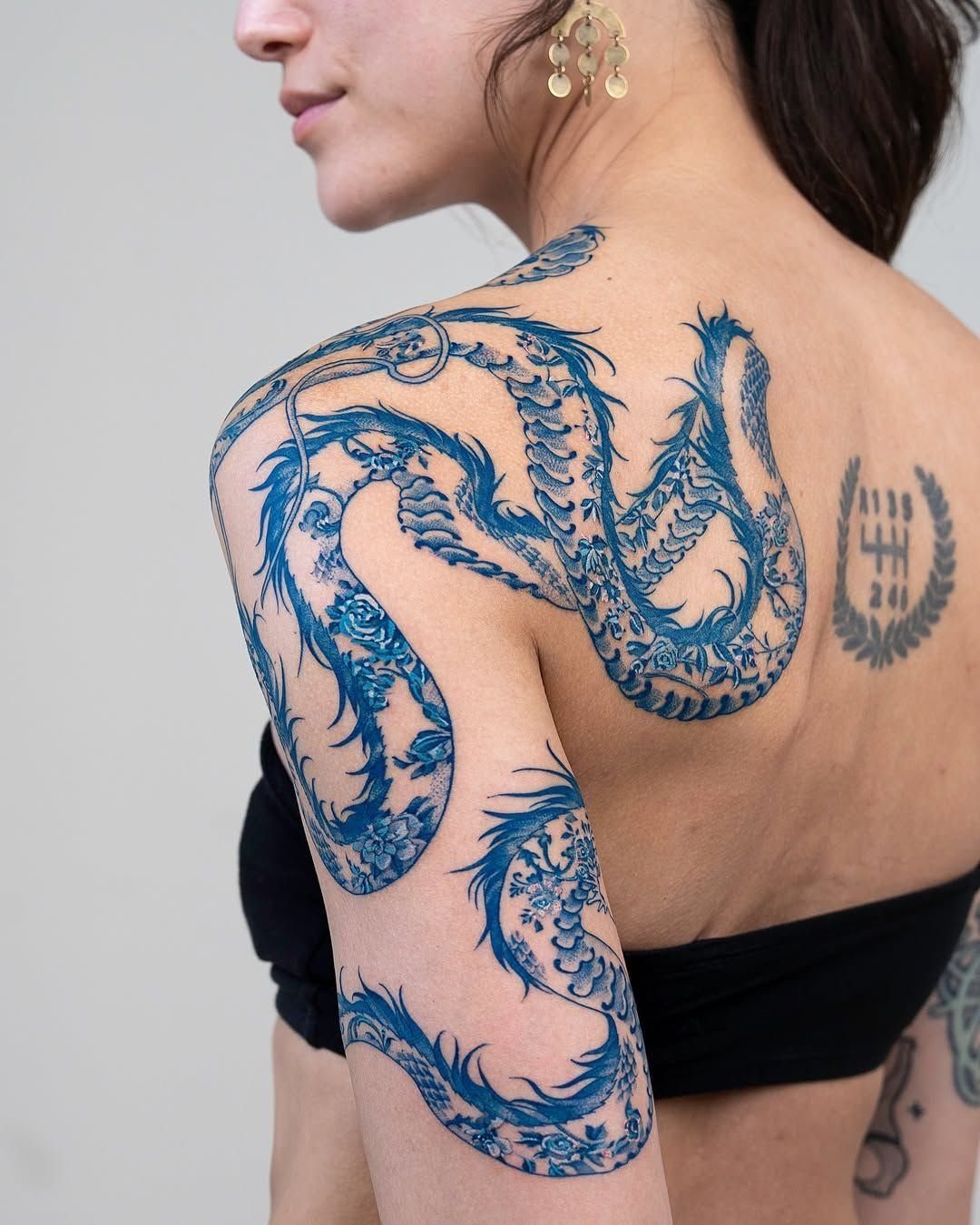
The dragon’s long body decides where it goes more than most designs do.
Sleeves, back, and chest are the classic answers because they give the length the form needs; force a dragon straight and it becomes a snake with extra steps.
I would start with the body’s natural flow, not with where I want ink. The shoulder to wrist, hip to knee, or shoulder blade to waist lets the coils turn the way the design demands.
A dragon that wraps the upper back and reaches the arm uses the shoulder as a hinge, so the body moves when the arm moves.
Check that your artist maps the wrap on skin, not just on paper; the body is round and the drawing is flat.

Package Include: You will receive 4 styles dragon stencils. Each size is approximately: 7.8x7.8 inch/20x20cm, more suitable for wall painting and can meet your large size decoration needs.

【Dragon Stencils Set Includes】: You will receive 49 pieces Dragon stencils totally,crafts each one has different patterns,each measuring 3×3 inch, providing you with a generous quantity to meet the needs of your DIY arts.

Mini Dragon Silhouettes: Small dragon silhouettes, wings, creature marks, and fantasy accent icons give the set a clear mini dragon silhouette look for fantasy cards, journals, tags, scrapbooks, small wood rounds, party favors, and mini signs
10. Serpentine Dragon Line Art Flash

Line art keeps the dragon in suggestion rather than statement: black ink, no fill, the scales and whiskers drawn as pure contour.
The serpentine shape, long and winding, comes from East Asian convention and fits flash sheets because it can stretch or compress without losing its nature.
A single session, no color to fade, and the design ages to a softer grey that some prefer to the original sharpness.
I would ask for consistent line weight; too thin and the whiskers blur before long, too heavy and the scales pool into black. The smoke background in the drawing is optional; on skin, negative space does the same work.

🐉 23 SHEETS 3D DRAGON TEMPORARY TATTOOS – 23 different black dragon designs featuring tribal, totem and mythology-inspired artwork. Includes 12 × 21 cm half-arm sleeve tattoos and 6 × 9.6 cm palm-size tattoos for different styling options.

Detailed Dragon Design – Large tribal dragon patterns contoured for the shoulder and arm, creating a realistic sleeve tattoo look.

【Unique Tribal Eye Design】: Stand out with bold tribal-inspired eye tattoos featuring gothic, boho and artistic patterns. Perfect for creating dramatic eye makeup looks for parties, festivals, cosplay and special events.
11. Whimsical Polka Dot Dragon
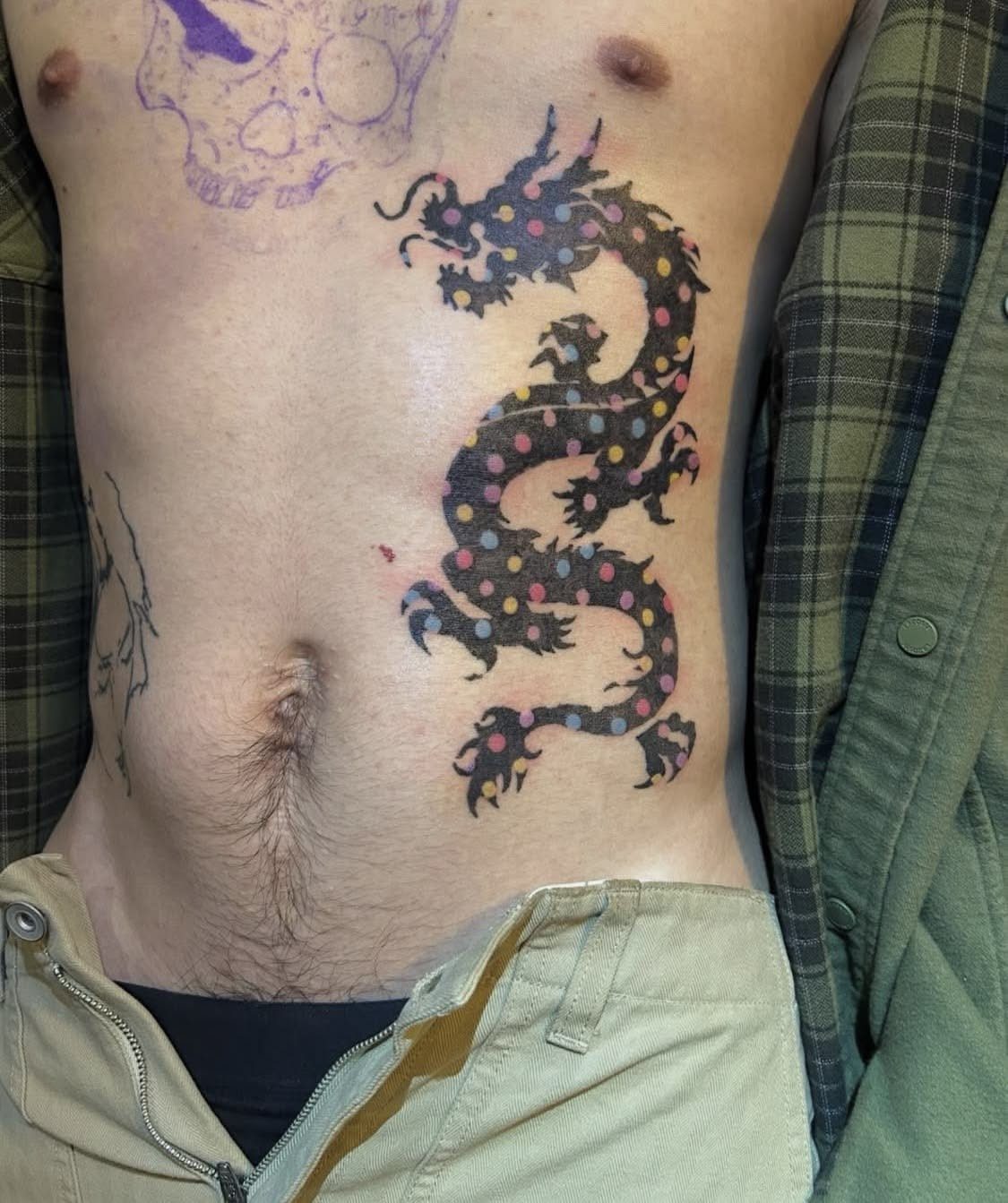
A silhouette filled with dots breaks every rule of dragon seriousness and ends up more memorable for it. The black outline holds the shape, the colored spots inside turn the creature into something closer to pop art than mythology.
I would keep the silhouette simple; the dots are doing the visual work, and scales or claws inside the shape fight against them.
The ribs or side, where the photo places it, gives the flat field the pattern needs. This suits someone who wants the symbol without the weight, or who already has a traditional dragon and wants its opposite.
The color in the dots will need touch-ups as the years pass; plan for that or stick to black dots on black outline.
Dragon Tattoo Styles
Japanese and Chinese dragons read as flowing color and fine line, while Western and tribal styles move toward bold black and graphic shape.
Tribal dragon tattoo style relies on bold black lines and geometric shapes rather than realistic detail, and that abstraction is why it holds up at a distance and why it ages cleaner than scaled work.
Tribal pieces sit best where the muscle gives them a round to follow: shoulder, upper arm, calf.
The solid black means fewer sessions and less money out of pocket, though you lose the creature-ness of the dragon in exchange for the symbol.
I would check that the artist understands the style’s origin in Pacific Island and Southeast Asian pattern-making; done without that grounding, it becomes decoration without weight.
Symbolism of Dragon Tattoos
The meanings cluster around power, but the kind of power changes with the dragon you choose.
Japanese dragons govern water and weather, Chinese ones carry the pearl of wisdom, Western ones guard hoard and territory. A tribal dragon leans on the shape itself as protective emblem, the silhouette standing in for the whole mythology.
I would pick the meaning first and let the style follow.
Want the idea of guardianship without the full narrative? The forearm coiled head facing outward reads as watcher.
Want the transformation story? The full back climb from waist to shoulder maps ascent literally onto your skin.
Best Placements for Dragon Tattoos
The forearm works for a single head or tight coil because the viewer is close enough to read detail. I would ask which approach they plan before the first needle touches.
The full back is the only placement where a dragon lives at the scale the form wants, but the commitment runs years and the sittings test endurance.
The shoulder blade to waist line lets the body coil or climb with room for background texture. A symmetrical wing spread reads as armor; an asymmetrical climb reads as motion.
Frequently Asked Questions
What does a dragon symbolize in a tattoo?
The meaning shifts with the dragon you pick. Japanese dragons carry water and weather, Chinese ones hold a pearl of wisdom, Western dragons guard territory and hoard.
Should a dragon tattoo face up or down?
Direction reads differently on skin. Neither direction is wrong, but the head’s aim changes what the tattoo says to someone looking at it.