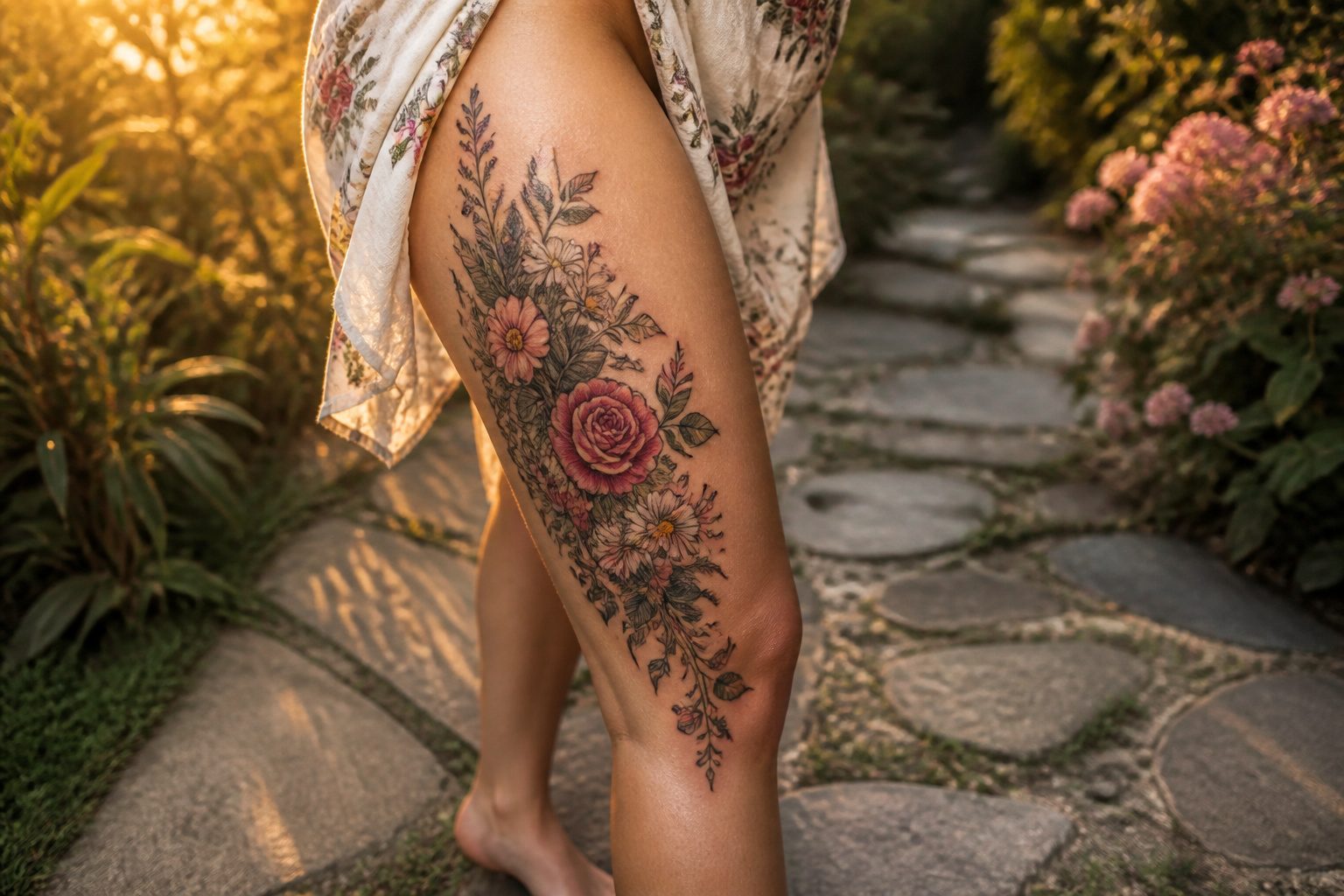
Side thigh flower tattoos for women range from a single daisy in an hour to a full wildflower meadow across multiple sessions, and the deciding factor is not your pain tolerance but how much detail you are willing to maintain.
A fine-line stem that looks delicate on day one blurs into gray threads within a few years on this placement, while bold neo-traditional outlines survive the stretch and friction that thighs endure daily.
Print your design at actual size and tape it to your leg before booking; the curve of muscle swallows detail faster than flat skin, and what reads intricate on paper turns to smudge at scale.
1. Rose Thigh Tattoos
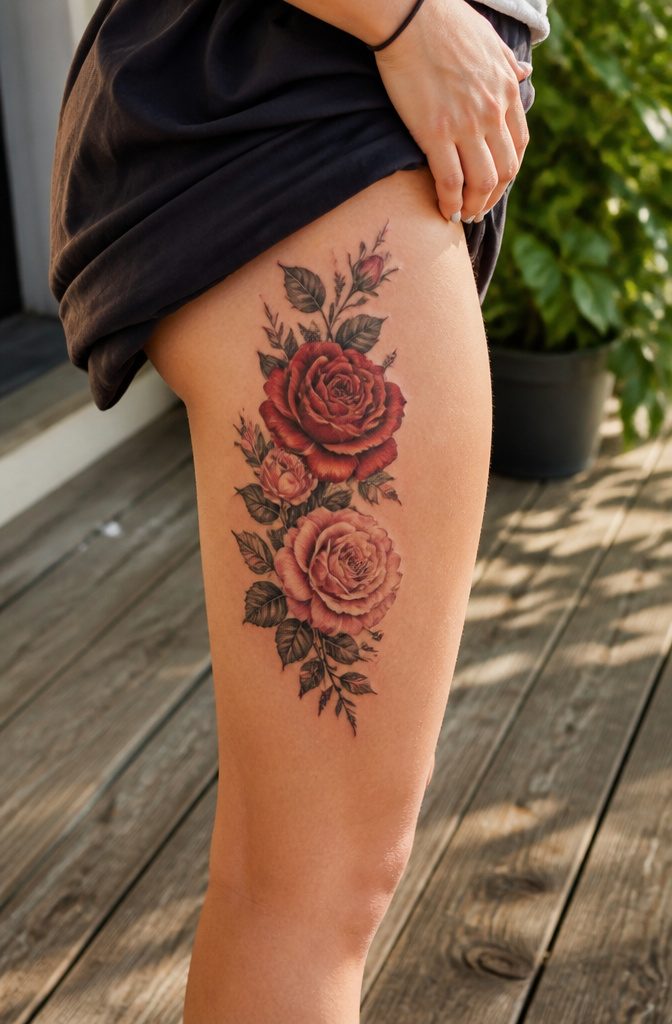
Roses carry the heaviest symbolism of any flower on skin, and that weight is exactly why they last. Love, resilience, and grief all sit in the layered petal structure, giving an artist real architecture to work with.
The contrast between dark shadow and open skin keeps the shape readable for years, which is more than can be said for finer florals that blur into soft masses as they age.
The thigh’s soft tissue handles this detail better than bonier placements. Muscle and fat cushion the needle, letting an artist lay in the tight linework a convincing rose demands without the vibration that ruins edges over ribs or ankles.
Three to six hours is the honest session time for a piece that holds up, and trying to rush that linework into two is where the petal edges die.
The real mistake is density. Two or three roses with breathing room between them will outlast a crowded garden of a dozen small ones every time.
Ask the artist to map the darkest shadow first; if the rose still reads in pure black, the color will only build from there.

【48H Natural Color Development | Realistic Large Sexy Peony Flower Tattoo】This semi-permanent tattoo features realistic sexy peony flower patterns. It looks silver at first, darkening naturally to a rich tone in 48 hours. Avoid sensitive skin like the face; cover with clothing while sleeping to prevent transfer. Perfect for back, thigh, arms and wrists, suited for adult men and women who love subtle lifelike body art

⚡High Quality Long-Lasting Sexy Flower Temp Tattoos for Womens -- look spectacular 24/7 for longer as our tattoos will last for several days. These sexy fake tattoo can show your personality and express your ideas.Guaranteed to dazzle, our black tattoos stickers are perfect for women girls to get noticed wherever you are.

【Elegant Large Flower design】This semi-permanent tattoo set features oversized floral compositions designed to make a statement. The flowing petals and balanced proportions create a powerful yet elegant look across thighs, legs, arms, or waist. A confident floral style that feels expressive, feminine, and visually striking.
2. Peony Thigh Tattoos
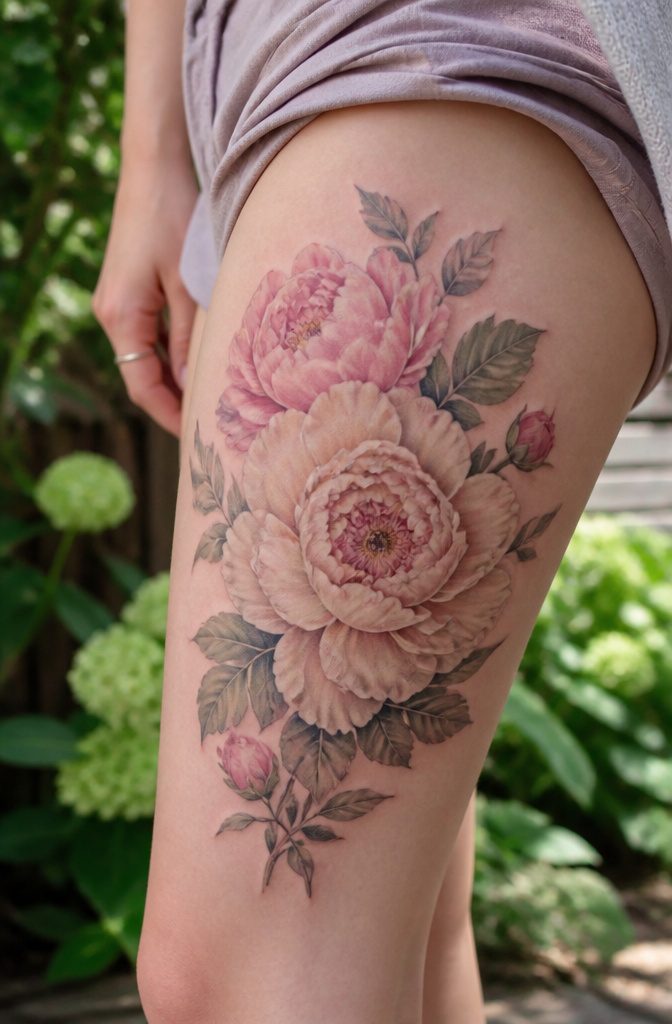
Peonies carry meaning that lands well on skin you live in: prosperity, romance, and honor, layered together so the tattoo reads differently at twenty-five than at fifty.
The flower itself builds volume through soft-edged petals that overlap like fabric folds, which lets an artist fill thigh space without hard outlines that age into stark geometry.
A single large peony with proper internal shading runs about four hours, and a three-bloom arrangement can push past eight.
That time buys natural coverage; the petals open outward and use the width of the upper or outer thigh rather than fighting the curve where the leg narrows.
Grey wash builds the depth, so the finished piece moves like cloth, not like a diagram pinned to muscle.
The session length means planning a Saturday with nothing after, not squeezing this between errands.
Peonies reward that patience. Where smaller flowers can look scattered on a thigh this size, a peony arrangement settles in and owns the space.

🌼 Beautiful Hand-drawn Fine Line Style Tattoos - Black and White Fine Line Flowers, Roses, Branch, Butterfly, Arrows, Hearts, Stars
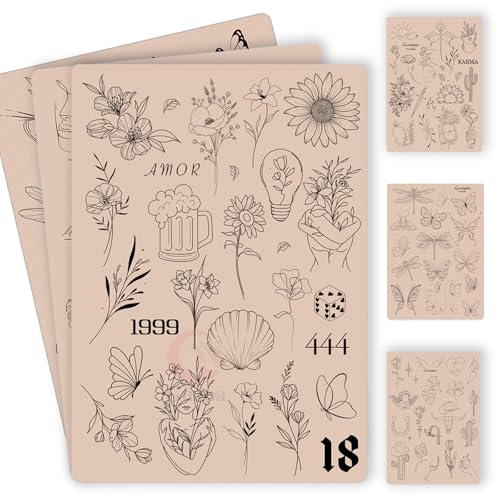
100+ Pre-Printed Designs – Features a wide variety of fine line and tiny tattoo stencils to enhance detailing skills.

Innovative Skin-Sync Technology: We don't just sit on the skin; we interact with it. By reacting organically with naturally occurring proteins in your skin's outermost layer (stratum corneum), our plant-based formula magically transforms from a transparent guide into a rich, ultra-realistic navy-black. It looks exactly like a healed, permanent tattoo—without the needles or depth.
3. Lotus Thigh Tattoos
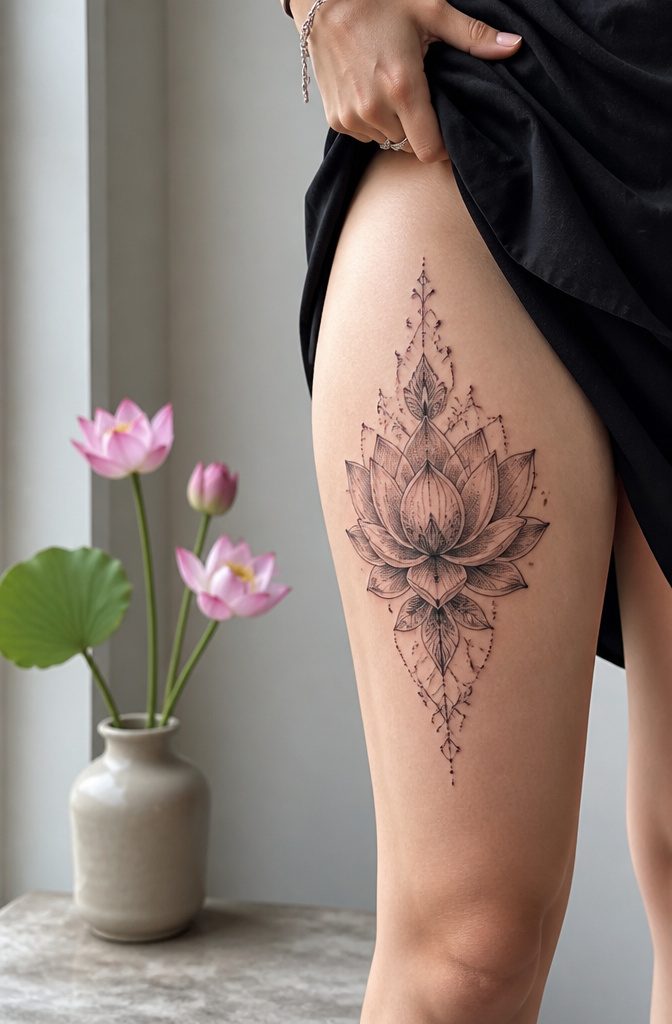
A lotus on the thigh carries weight before it ever touches ink.
Across Buddhist and Hindu traditions, the flower stands for rebirth, for rising through mud and still opening clean. People choose it for what it says more often than for how it looks, which is rare among florals.
The lotus is also the most symmetrical flower in the tattoo vocabulary, and that symmetry is both gift and trap.
Centered on the front of the thigh, a symmetrical design sits with natural balance, but any wobble in line work shows instantly because the eye has a mirror image to compare against.
This is not a piece for an apprentice portfolio. Ask to see healed photos of the artist’s symmetrical work specifically, not just fresh pieces where swelling still hides minor flaws.
Session time runs 2–5 hours depending on scale and whether you add surrounding elements like mandalas or fine-line accents.
Placement high on the outer thigh keeps it under everyday clothing, while a central front placement asks for confidence in the symmetry and in the artist’s steady hand.

【Natural & Skin-Friendly】Made with plant-based extracts and free from harsh chemicals, UBICA semi permanent tattoos are gentle on all skin types—even sensitive skin. Express yourself without irritation!

★【6 Pieces/LOT】--COKTAK Brand Temporary Tattoos Sticker in package.【Size】: 20x15CM 7.8"x5.9"

【48H Natural Color Development | Realistic Large Sexy Floral Unique Tattoo】This semi-permanent tattoo features realistic large sexy peony floral patterns. It looks silver at first, darkening naturally to a rich tone in 48 hours. Avoid sensitive skin like the face; cover with clothing while sleeping to prevent transfer. Perfect for back, thigh, arms and wrists, suited for adult men and women who love subtle lifelike body art
4. Sunflower Thigh Tattoos
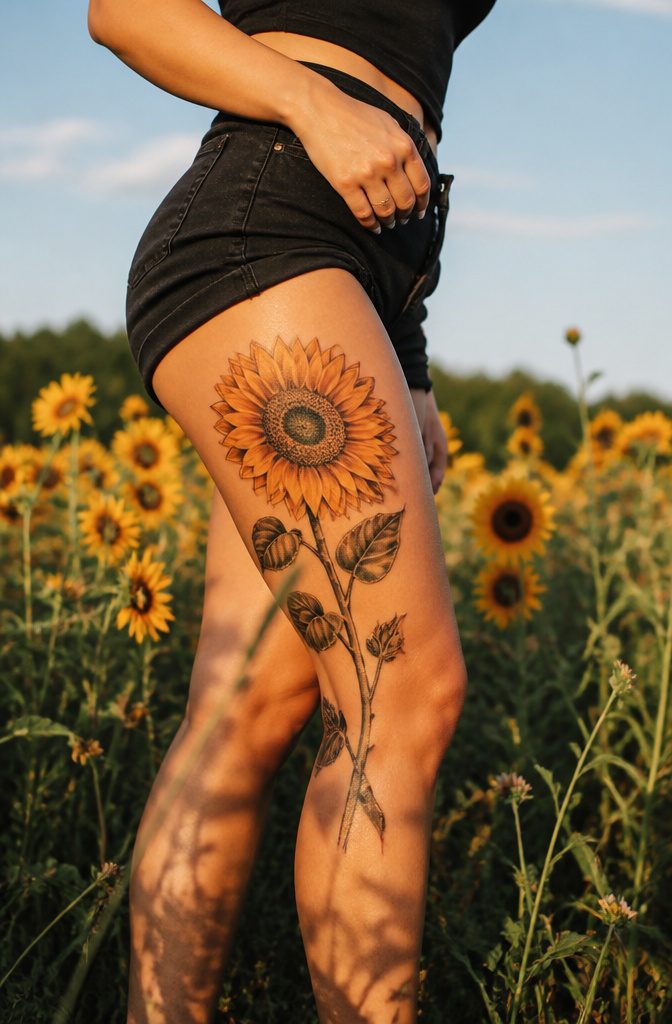
Sunflowers carry warmth, loyalty, and optimism in a way that feels earned rather than decorative, and that matters when the tattoo sits on a body part you see every morning.
The tall stem and broad head follow the thigh’s vertical line naturally, which is why this placement works so well: the eye travels up the leg the same way the flower grows toward light.
A single large bloom wins over a cluster. The sunflower is already visually loud, and repeating it three or four times across the thigh dilutes the impact rather than building it.
One strong piece centered on the side thigh, stem running down toward the knee, gives the shape room to breathe.
The technical challenge sits in the center. That packed dark disk of black or deep brown needs a confident hand or it scars and patches during healing, while the petals stay simple and forgiving by comparison.
Session time runs 3–5 hours, and the yellow-to-brown gradient is where the whole design lives. Color is worth the extra time here; the transition is the point.

🐙32 Sheets 89+ PCS Unique Tribal Black Temporary Tattoos:🐠 There Are 32 Sheets With 8 Large Half Arm Sleeve Temporary Tattoos For Women Adults 21x15cm 8.2"x5.9" And 24 Sheets Small Temporary Tattoos For Girls Kids 10.5x6cm 4.1"x2.3" Including Various Popular Gothic Designs 3D Animal Snake Lace Elephant Cross Boho Bohemia Moon Crown Owl Lion Wolf Tribal Tiger Tatoos Skull Skeleton Dreamcatcher Dream Catcher Turtle Lotus Mandala Flower Feather Fake Jewelry Tattos Design.

【Spiritual Lotus & Moon Designs】This semi-permanent tattoo set features minimalist fine-line designs inspired by lotus flowers, crescent moons, flowing vines, and subtle star accents. Symbolizing renewal, inner balance, and feminine energy, these delicate elements blend Eastern spirituality with modern aesthetics. Perfect for minimalist lovers, yoga and meditation enthusiasts, and those drawn to spiritual, calming, and quiet strength with effortless style.

Product Includes: You will get 8 sheets of lace temporary tattoos, meet most of your needs
5. Cherry Blossom Thigh Tattoos
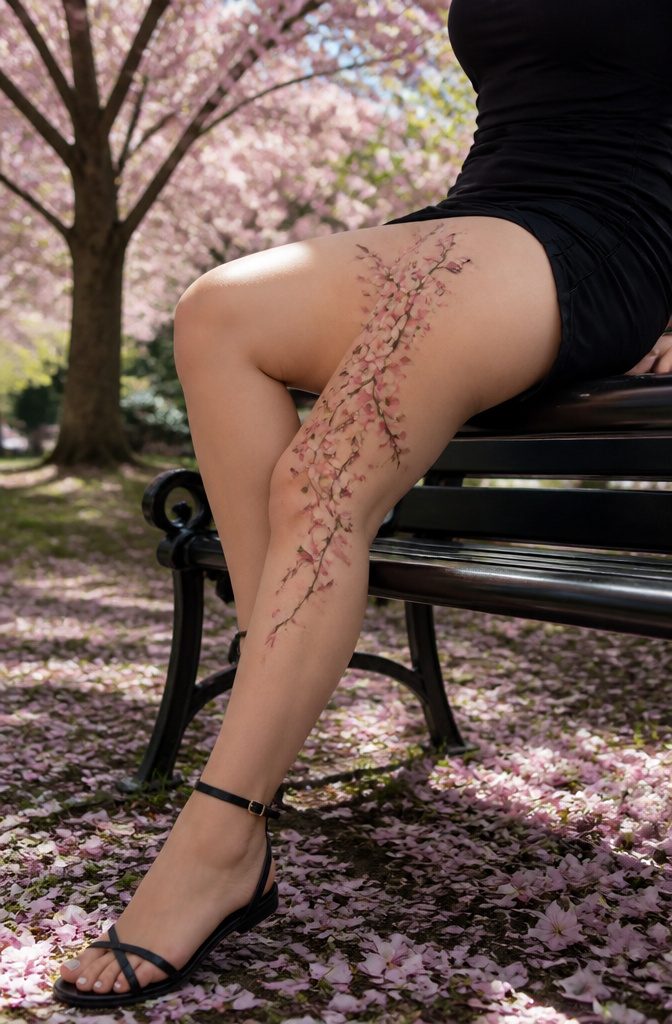
Cherry blossom thigh tattoos carry a meaning that outlasts their trend status.
The symbolism of impermanence and renewal draws women who have lived through something and want the mark to say so without spelling it out. A branch in full bloom and already shedding petals tells that story in a single image.
A branch can start high on the outer thigh and trail toward the knee, following the leg’s natural curve rather than fighting it.
The blossoms are small and scattered, so the design stays flexible, sparse or dense depending on what you want. Session time runs 3–7 hours for a piece that wraps, though a single branch might finish in one sitting.
The flowing branch designs work because the thigh is a curved surface. Petals and stems are curved shapes, so the composition sits naturally where a flatter design would look forced.
That said, the small scattered petals blur first. Keep them larger than they look on paper and leave clear skin between them.
I have watched people start with a branch and thirty blossoms, live with it for a year, then add more, which is much harder to do with a single large peony.

🐙2 Sheets Creative Large Flower Temporary Tattoo Sleeve:🐠 There Are 2 Sheets Full Arm Temporary Tattoos For Women Full Sleeve Temporary Tattoos For Adults Including Popular Unique Designs Black 3D Rose Peony Flowers Tattoos Watercolor Butterfly Flamingo Floral Tattoos Full Sleeve Thigh Leg Tattoo Sticker.

💕【27 Sheets Creative Watercolor Flower Temporary Tattoos For Women】--VANTATY Unique Desgin Mixed Style 3D Rose with butterfly Temporary Tattoos For Adults Body Art Stickers Look Real! Package Includes 12 Sheets 7.8"X3.7" Inches/19.8x9.6cm Large Watercolor Temporary Tattoos For Thigh Leg Forearm And 15 Sheets 3.86"X2.28 Inches/9.8x5.8cm Small Temporary Tattoos For Fingers Hands. This Product Is Not Suitable For People Under 12 Years Old.

💕【65 Sheets Flower Temporary Tattoos For Women 】--VANTATY 3D Realistic Floral Rose Peony Temporary Tattoos For Adults Women Kids Adults Girls Body Art Stickers Look Real! 【Click Our Store/Brand Name To See More Fashion Designs】Dandelion Sunflower Birds Lotus Mountain Wolf Snake Sea Weave Animals Tiger Skull Skeleton Lion Crown Spider Spiderweb Bat Dragon Scorpion Anchor Pirate Butterfly Compass Triangle Geometric dolphin Elephant Tattos Indian Feather Bowknot.
6. Orchid Thigh Tattoos
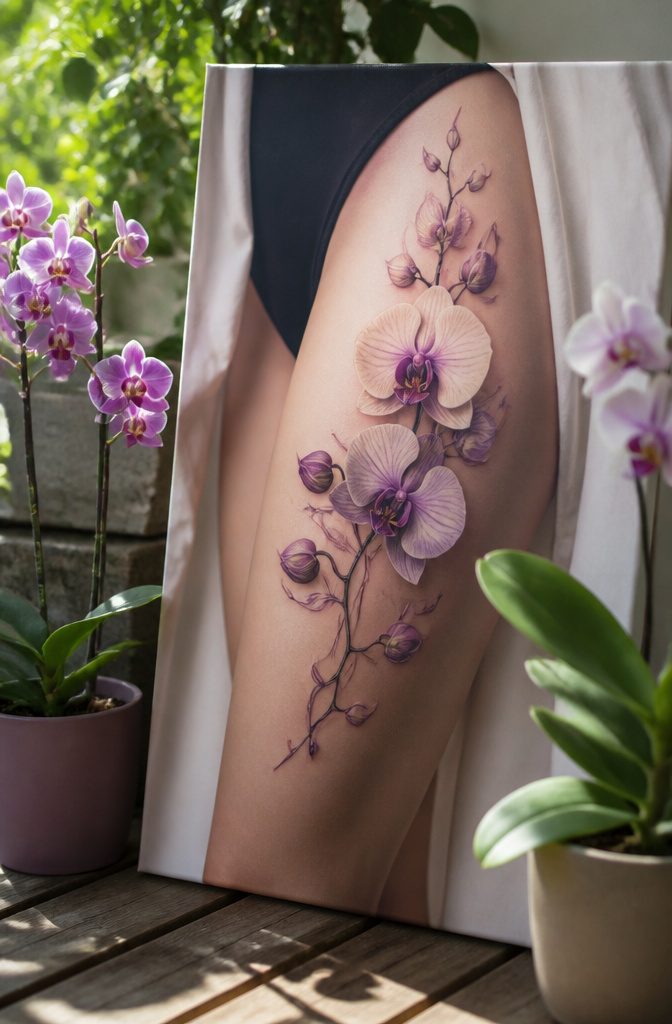
An orchid on the thigh carries a quieter symbolism than the louder blooms most people pick.
Rare beauty and refinement are what this flower has signified across centuries, which lands differently on skin than love or luck. The meaning fits a placement that stays mostly hidden, visible on your terms.
The architectural shape is what makes orchids work here.
Long stems and negative space let the tattoo follow the muscle line without fighting it. Inner thigh or outer, the slender form stretches with the body instead of looking stamped on.
Session time runs 3–6 hours, depending on whether you commit to color or keep it black and grey. The linework has to stay precise; a wobble in those petals reads as a mistake, not character.
I have watched people shrink an orchid down to fit a too-small spot and lose the whole reason it works on skin. The negative space between stem and bloom needs room to breathe.
At least palm-sized, maybe larger, or the detail collapses into a blob within a few years. The thigh gives you that real estate, which is why this pairing of flower and placement holds up where smaller spots fail.
[LARGE SIZE & LARGE QUANTITY] Large size flowers collection tattoo stickers can cover your body parts larger, size is 9.45 * 5.35 inch (24 * 13.6cm) 10 sheets, 3.9 * 2.3 inch (9.8 * 5.8cm) 30 sheets .You can share it with your family and friends

【Develops Fully in 48H】Your unique design realistic large sexy flower thigh temporary semi permanent tattoo will initially appear silver before naturally darkening to a rich finish within 48 hours. For optimal results, avoid contact with bare skin (particularly the face) and cover the area with clothing during sleep to prevent transfer. Realistic Moon star floral & wing boho designs for hand back thigh wrist arm temporary fake tattoos for women adult

92 Sheets Black Tattoos: Realistic temporary tattoos Includes 17 large flower temporary tattoos and 75 small sexy tattoos – featuring rich designs such as roses, leaves, and butterflies, mixed and matched to create your own unique flower arrangement on your body.
7. Daisy Thigh Tattoos
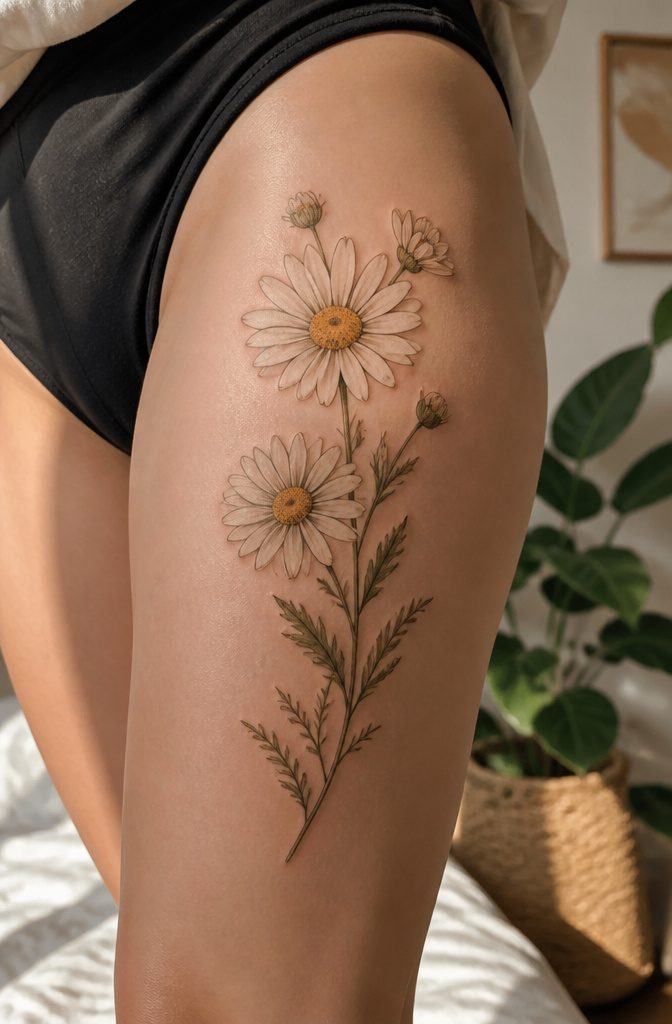
Daisies carry the oldest symbolism on this list, innocence and new beginnings, which makes them land harder for anyone standing at the start of something.
A first tattoo, a first thigh piece, a first hour in a chair: the meaning lines up with the moment.
The session runs 1–3 hours, the shortest commitment here. A small cluster on the outer thigh sits quietly under everyday clothes and shows only when you want it to.
That low profile is honest practice for wearing something permanent. You find out whether the placement works for your body before you ever book a nine-hour sitting.
Line weight matters more than detail. Very fine outlines on daisies top the list of pieces artists end up retouching, so ask for slightly heavier linework than the design seems to need.
Clean lines carry the whole piece. What starts small also builds outward cleanly; several of the best wildflower thighs I have seen began as a single daisy grouping that grew over two or three years into something sprawling.

Tiny Tattoo Practice Skin: the double-sided, easy-wipe, fine-line tattoo practice skins feature over 80 different stencil designs on the front and back of the skin.

Premium Quality 1.5mm Silicone Material – Crafted from premium 1.5mm thick silicone, this tattoo skin offers a true-to-life feel with excellent durability and a smooth surface for effortless needle movement during practice.

Swallow Botanical Quote Dual Design: This semi-permanent tattoo pack includes two unique sheets. One holds flying swallows, single rose blooms, butterflies and "Nothing Lasts Forever" cursive text; the other features symmetrical long leaf vine strips. Swallows symbolize hope & travel, roses stand for growth, the quote embraces life’s fleeting beauty. Ideal for nature & word tattoo lovers for layered arm body adornments.
8. Wildflower Thigh Tattoos
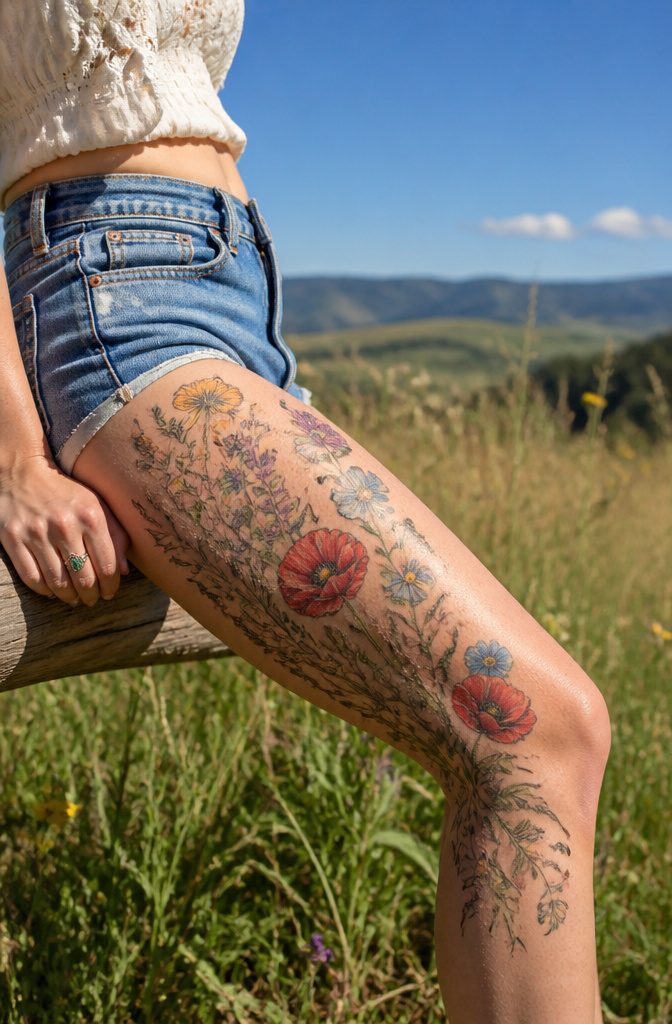
Wildflower thigh tattoos carry the most personal weight of any floral piece, and the most risk of looking scattered without a plan. The draw is obvious: blooms that grew where you came from, or from a particular garden someone kept.
Poppies show up constantly in these designs, though any native species can anchor the work. Freedom and memory both live here, the tattoo tied to place in a way a rose or peony rarely is.
The session time runs 4–9 hours, the longest commitment on this list. That spread depends on how densely the meadow fills the thigh and how many species your artist weaves together.
Mixed stems and buds work best with one dominant bloom leading the composition, everything else scaled to support it. Without that hierarchy, the result looks like a sticker sheet, each flower fighting the next.
Planning matters more here because retrofitting a composition around existing tattoos is far harder than building one from the outline up. Agree the full outline before the first session, even if you plan to fill it over years.
A bouquet shaped to the thigh’s curve reads as intentional; loose scattered flowers running down the leg read as accidental unless the spacing is deliberate and repeated.

LARGE: Sheet size 6"X 8"

🌼【VARIETY OF POPULAR PATTERNS 】Package Includes 17 Sheets Large 7.8"x3.7" Inches/19.8x9.6cm Creative Unique Design Mixed Style Realistic Peony Rose Flowers Temporary Tattoos For Women Half Arm Sleeve Tattoo Stickers. 3D Gothic Animals Temporary Tattoos Floral Book Lotus Jewelry Pendants Wolf Lion Dog Butterfly Panda Turtle Buddha Tattoos Animals With Flowers Hot Fashion Popular.

🎡【Package Includes:】 71 Sheets Watercolor Temporary Tattoos For Women Men Adults Including 12 Sheets Half Arm Sleeve Tattoo Stickers and 59 Sheets Tiny Cute Small Fake Tattoos For Kids Boys Girls, 3D Gothic Tatoos Universe Planets Star Moon Spider Web Cross Birds Scorpion Bat Ghost Elephant Flower Floral Pirate Compass Anchor Butterfly Skull Skeleton Maori Totem Wolf Tiger Lion Dragon Eagle Owl Bear Crown Mountain Sea Wave Snake Tree infinity Letter Words Clock Quotes Abstract ECG Feather Gangster Minimalism Coyote Feather Astronaut Whale Lotus Dreamcatcher.
Thigh Pain and Healing
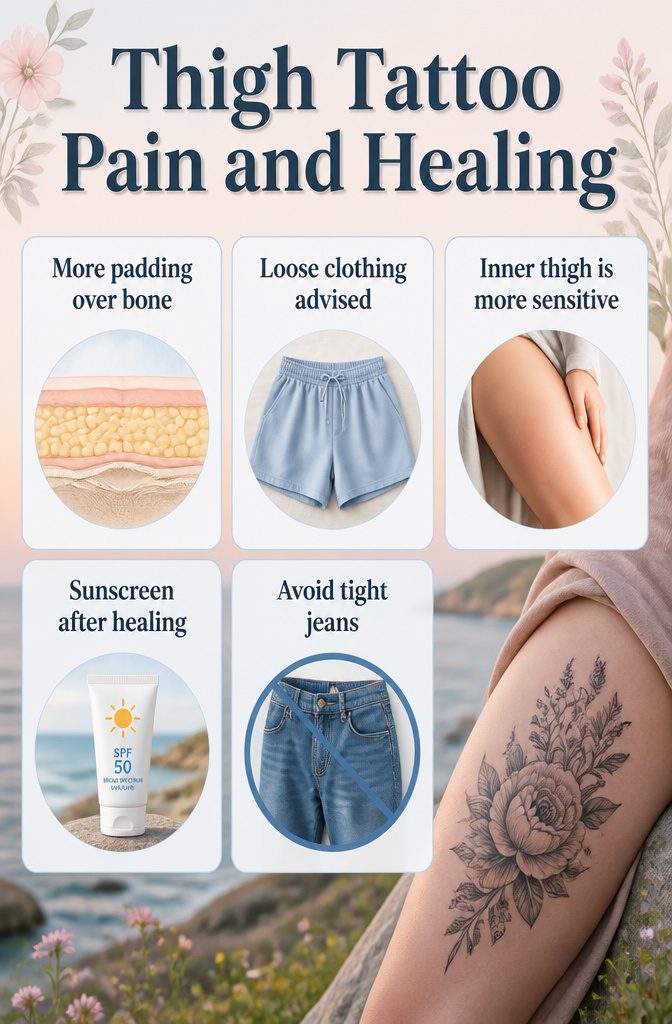
The thigh carries more soft tissue over bone than almost any large tattoo placement, which is why artists so often steer nervous first-timers here instead of toward ribs or sternum.
That padding generally means a more tolerable session and a cleaner heal, though you pay for it with friction.
Thighs rub against each other when you walk and press against fabric all day, and a healing tattoo that is constantly being rubbed can lose pigment in patches.
Loose clothing for the first two weeks is the practical fix.
Skip gym leggings and tight jeans, and be deliberate about not sleeping with the healing thigh pressed against your other leg. I have seen more patchy heals caused by tight denim than by anything an artist did.
The inner thigh is a genuinely different experience from the outer thigh. Skin there is thinner and considerably more sensitive, and every artist I have asked confirms it is the part of the leg clients ask to stop on.
If you are sensitive to pain or doing your first large piece, the outer thigh is the smarter starting point.
Once healed, sunscreen becomes the highest-value habit.
Sun exposure fades color faster than age does, and the thigh sees a lot of it in summer. Detailed floral work is the most vulnerable to that fade.

SACRED LOTUS MANDALA ART: Features a breathtaking vertical alignment of blooming lotus flowers, a celestial crescent moon, and intricate unalome geometric mandala detailing. This elegant spiritual design is crafted using a digital hand-drawn fine line tattoo ensures crisp lines and flawless gradient shading to maintain absolute geometric symmetry, rich linework contrast, and clean dotted stippling effects.

🌊【14 SHEETS Lotus Chain Temporary Tattoos For Women Adults】GOROMON Unique Design Waterproof Realistic Lotus Tattoos Including 14 Sheets Geometric Flower Lotus Crescent Moon Pendant Arrow Fake Jewelry Chains Tattoos For Hands And Tattoos For Neck Tattoo Sticker.

Innovative Skin-Sync Technology: We don't just sit on the skin; we interact with it. By reacting organically with naturally occurring proteins in your skin's outermost layer (stratum corneum), our plant-based formula magically transforms from a transparent guide into a rich, ultra-realistic navy-black. It looks exactly like a healed, permanent tattoo—without the needles or depth.
Mistakes I Have Watched People Make
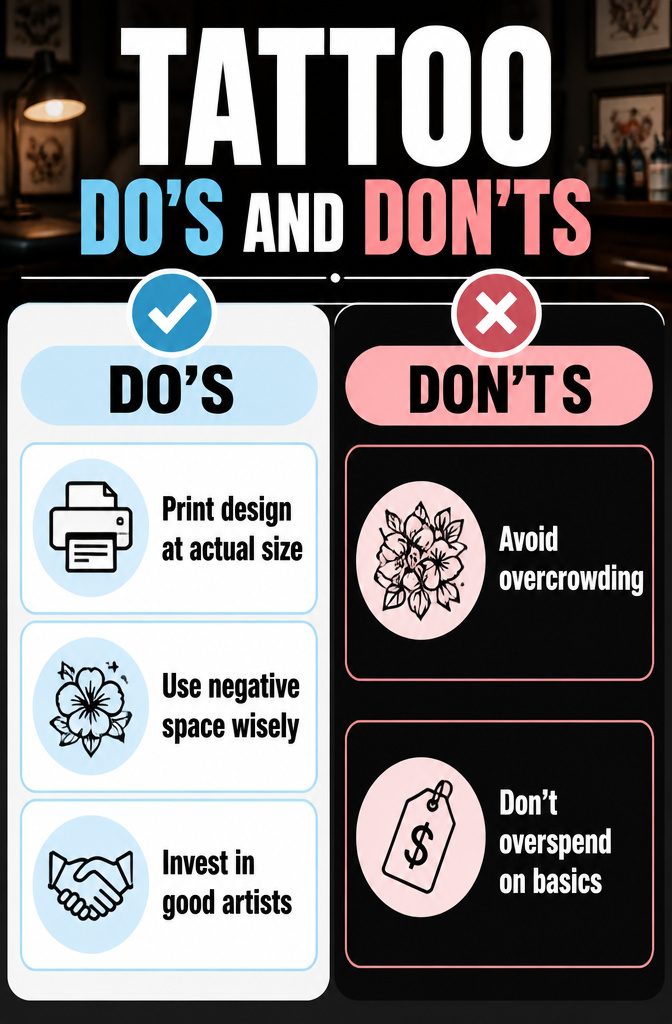
A forearm-sized design looks lost on a thigh, and that is the regret I hear most often from women who went ahead with side thigh flower tattoos.
The curve of the leg swallows detail; what reads as intricate at 4 inches turns into a smudge at 8. Print the reference at actual size and tape it to your leg before the appointment — two minutes that prevents a permanent mismatch.
The second mistake is treating every inch of skin as territory to conquer. Negative space is not leftover space; it is what lets the eye find the flower.
The pieces that look most expensive usually carry the most clear skin in them. Filling the canvas reads as busy, not lush.
Price shopping for an artist lands people in cleanup work later. A side thigh piece sits where denim rubs and the body moves, so line quality matters more than it does on a shoulder blade.
The difference between a rate that covers proper time and one that does not shows up in two years, not two weeks.

Realistic Floral Temporary Tattoos: Botanical wildflower inspired designs with fine lines and soft watercolor tones; lifelike artistic floral styles for adult temporary tattoos

💕【4 Sheets Creative Large Flower Temporary Tattoos For Women】--VANTATY Unique Desgin Watercolor 3D Rose Butterfly Temporary Tattoos For Adults Body Art Painting Stickers Look Real! Package Includes 4 Sheets Large Watercolor Lily Temporary Tattoos For Thigh Hips Buttock Leg Arm Tattoos Lily Tattoos Butterfly with Flower Rose Temporary Tattoo Sticker.

Dual Wildflower Peony Vine Design: This semi-permanent tattoo pack holds two distinct vertical floral sprigs with different bloom motifs. One sheet features full layered peonies with dense shaded foliage; the other carries five-petal wild blossoms paired with closed tulip buds and thin outlined leaves. Peonies stand for gentleness and inner prosperity; wild flowers symbolize freedom and quiet growth, while tulip buds represent new beginnings and gentle hope.
Styles That Change Everything
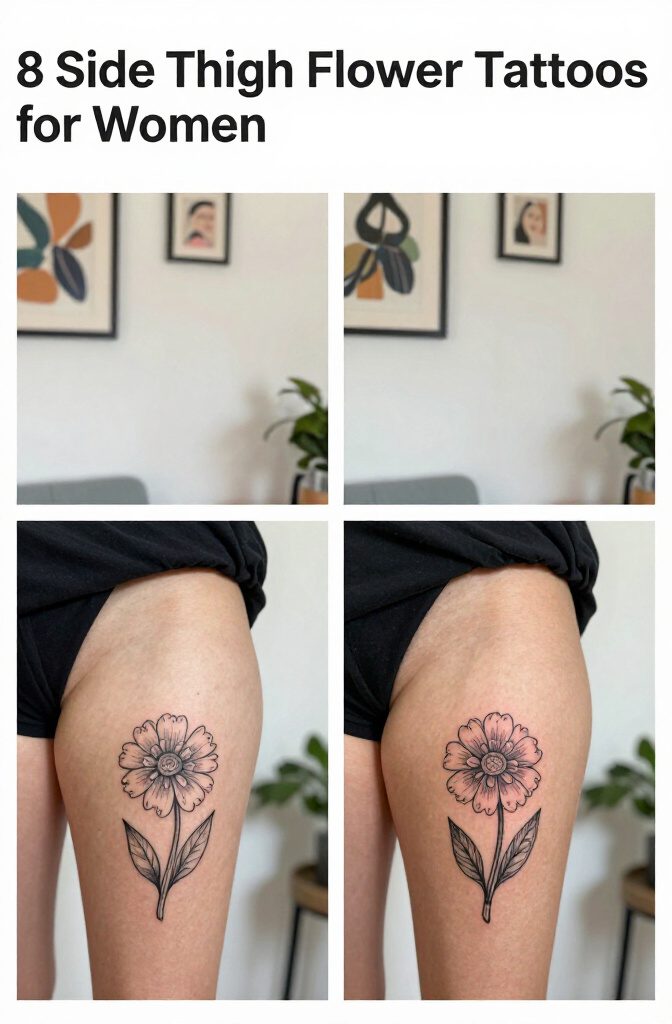
Neo-traditional is the style I recommend most often for a flower on the side thigh: bold outlines do the structural work that keeps petals readable as the interior color softens over the years.
The thigh is generally seen from across a room, not at arm’s length, and heavy line work survives that distance in a way fine line simply does not.
Fine line is the one I have watched fade fastest on this placement.
The skin here moves and stretches more than the forearm, and hair-thin stems blur into gray threads within a few years. It looks delicate on day one; the healed result is usually a cover-up consultation.
Black and grey holds up well and costs less in chair time, but it flattens the depth that makes a flower recognizably itself.
A rose in monochrome reads as a dark shape unless the artist builds contrast with deliberate negative space.
Full color gives the brightest initial result and demands the most maintenance; the reds and yellows are first to muddy, especially where the thigh rubs against denim or leggings.
Illustrative sits between neo-traditional and realism: softer edges, more painterly, but still anchored by enough line work to guide the eye.
It works if you want color without the poster-flat look of old-school work. On a curved thigh canvas, that middle ground usually wins.
Frequently Asked Questions
What do different flower tattoos symbolize?
Roses hold layered meanings of love, resilience, and grief; peonies carry prosperity, romance, and honor; lotus flowers stand for rebirth and rising through difficulty; sunflowers signal warmth, loyalty, and optimism; cherry blossoms mark impermanence and renewal; orchids represent rare beauty and refinement; daisies symbolize innocence and new beginnings; and wildflowers tie to freedom, memory, and specific places you come from.
How long does each side thigh flower tattoo take?
Session times run from 1 to 9 hours depending on the flower and design density.
A small daisy cluster takes 1 to 3 hours; a single lotus runs 2 to 5 hours; a rose needs 3 to 6 hours; a sunflower or orchid lands at 3 to 5 or 3 to 6 hours; a cherry blossom branch wraps in 3 to 7 hours; a single large peony hits 4 hours and a three-bloom arrangement can push past 8; and a full wildflower meadow spans 4 to 9 hours, the longest commitment on the list.
What are common mistakes to avoid when getting a thigh tattoo?
The biggest error is sizing too small: print your reference at actual size and tape it to your leg before booking, since the thigh’s curve swallows detail that reads fine on paper.
Packing every inch with design is another misstep; negative space lets the eye find the flower, and clear skin reads as expensive rather than empty.
Price shopping also backfires, since the thigh moves and rubs against fabric, making line quality matter more here than on a shoulder blade.
How painful is a thigh tattoo for a female?
The outer thigh ranks among the more tolerable large placements because muscle and fat cushion the needle, though the inner thigh is genuinely different.
Skin there is thinner and more sensitive, and clients regularly ask to stop when work moves inward.
Friction during healing causes more trouble than the session itself; loose clothing for two weeks prevents patchy pigment loss from the thigh rubbing against itself or tight denim.
What is the prettiest flower to get tattooed?
No single flower wins objectively, but each carries visual strengths that suit different women.
Peonies fill thigh space with soft volume that ages like fabric rather than geometry; lotus designs carry symmetrical balance that demands a steady hand but rewards with centered presence; sunflowers follow the leg’s vertical line naturally with one strong bloom; and orchids stretch along muscle with architectural negative space that stays hidden until you choose to show it.
What tattoos look good on thighs?
Flowers that follow the body’s lines work best: stems running down toward the knee, branches trailing the leg’s curve, or single large blooms that use the thigh’s width without fighting where the leg narrows.
Neo-traditional style holds up strongest here, since bold outlines keep petals readable from across a room and survive the stretching and movement this placement sees. Fine line fades fastest on thighs and usually ends in cover-up consultations.
What does a thigh tattoo mean for a woman?
Meaning varies by flower rather than placement, though the thigh itself offers privacy on your terms and a scale that lets designs breathe.
A lotus on the thigh carries spiritual weight from Buddhist and Hindu traditions; cherry blossoms there mark lived experience without spelling it out; wildflowers tie to home and memory; and daisies often land at life transitions, the placement matching a moment of starting something new.