Botanical blackwork tattoos run from a single forearm leaf finished in one sitting to a full sleeve built across multiple sessions over months, and the list below covers the styles, placements, and techniques that make each one work.
Your budget and how much time you can give the chair decide which of these 8 approaches fits.
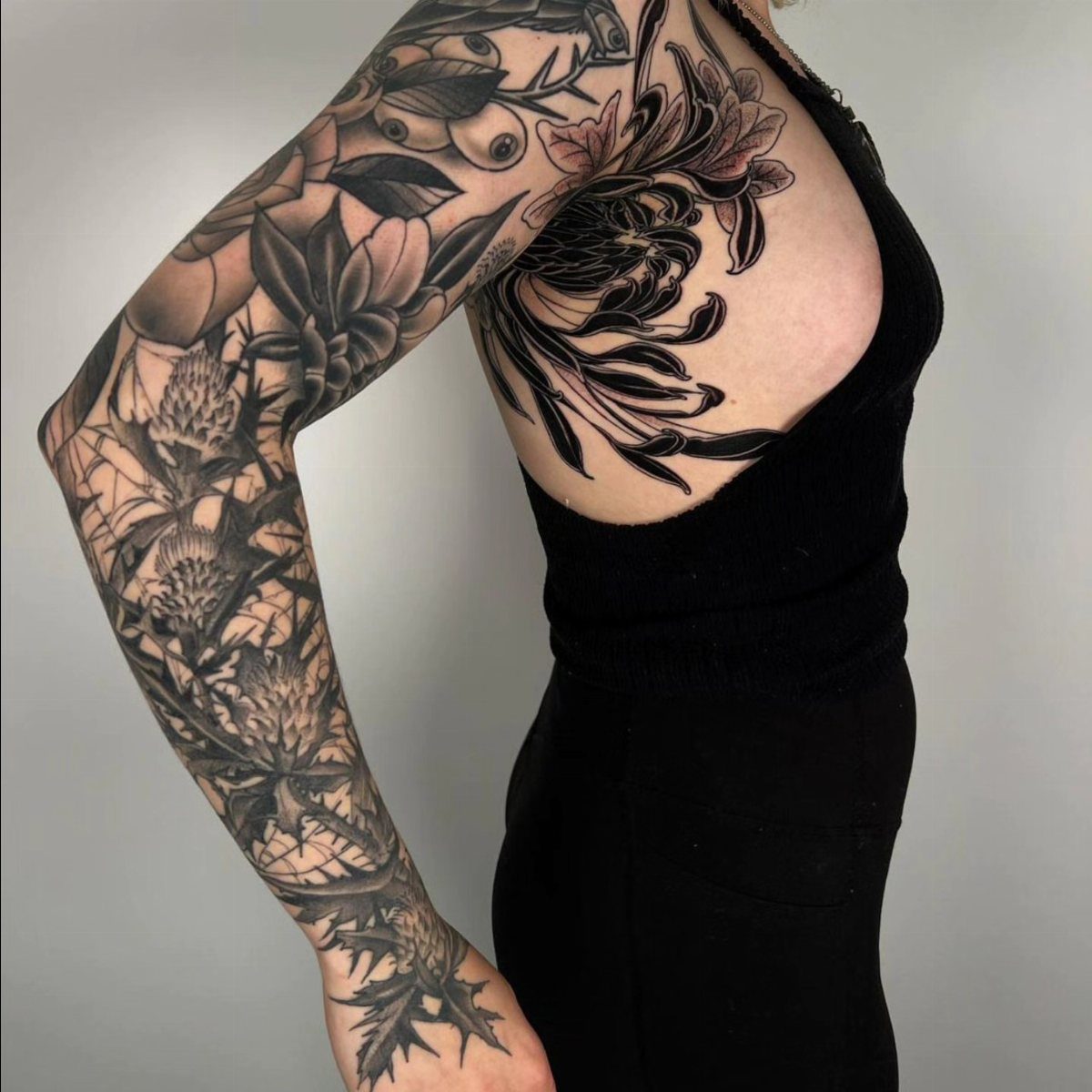
Adam LoRusso’s stippled arrangements show how alternating large blooms with tight dotwork keeps dark passages from going flat, a technique that matters whether you are covering a small area or building a full sleeve.
1. Floral Tattoo Sleeve

A floral sleeve pulls the eye along the arm in one continuous story rather than stopping at a single flower.
I like how Adam LoRusso builds his black and grey arrangements, alternating large blooms with tight stippling so the dark passages never go flat.
The roses and lilies in this piece keep the eye moving up the arm, all the way onto the hand where the butterflies land.
For your own sleeve, ask whether you want the flowers to read as a garden or a bouquet.
A garden grows upward, a bouquet clusters. That choice decides where the heavy black sits and where the fine lines catch light on the wrist.
Either way, budget for multiple sessions; even a fast hand needs serious time for this much coverage. Lines that fresh will need touch-up as they settle.


2. Fine Line Botanical Tattoos

Fine line botanical work lives or dies by the needle. Single needles and tight groupings hold detail that a 7-round liner would swallow; those lines spread faster on skin that sees sun or ages hard.
I have watched thin stems go fuzzy in 3 years on a forearm that never saw sunscreen.
Wildflowers arranged vertically follow the arm’s natural line and stretch less than a horizontal band. Vines and ferns fill gaps without demanding symmetry, which matters because bodies move and settle.
Ask your artist whether they use a 3 or a 1 for the hairlines, and whether they back the fine work with slightly heavier leaves that will still read when the thinnest passages soften.

LARGE SIZE AND MORE QUANY -- Total 77 Sheets Temporary Tattoo Stickers for Men and Women Adults Including 17 Sheets Large Size (7.48*3.74 inches) and 60 Sheets Small Size (3.85*2.28 inches), The large size can cover more arm area and the small size can show your personality

BLACK AND WHITE FUN: Get ready to embrace the allure of monochrome mystique with Savvi's Black and Gray Flash Temporary Tattoo Pouch. This isn't just a pouch; it's a gateway to a world of sleek sophistication.

SAFE FOR ALL SKINS BLACK VAMPIRE HALLOWEEN FLYING BATS TEMPORARY TATTOOS - contains 1 sheets vampire halloween bat temporary tattoos which are printed with non-toxic ink, Your friends will think you had a new viking style tattoo! Great fun for parties, cosplay, halloween, special events Also for testing to see if you like a real tattoo look like
3. Peonies and Magnolias in Black Ink

Peonies carry weight in black ink; their layered petals give the artist natural shading zones that magnolias lack.
A magnolia reads as shape and negative space, a peony as depth. Both flowers work together when the magnolia’s open cup balances the peony’s packed center.
Solid black shading behind either flower will heal lighter than it looks fresh; plan for that adjustment or the contrast drops once it settles.
I prefer stipple shading for botanicals because it ages like etching, where smooth grey can muddy. If you want fish or another element threaded through, place it where the flower density drops so both elements keep their breathing room.

Package: 50pcs mixed tattoo cartridge needles, includes 10pcs each of 1203RL, 1205RL, 1207RL, 1209RL, 1211RL.

Dragonhawk Tattoo Needles: High-quality tattoo needles, manufactured under the trusted Dragonhawk brand, are perfect for all-purpose work. With a polished, long taper design, these needles ensure reliable performance and excellent control.

4. Dark Botanical Tattoos

Woodcut linework gives dark botanicals their backbone: not smooth greyscale but carved black and white, the way old illustrations printed.
Datura uses that language exactly, with crosshatched darks and sudden negative-space highlights that would read as gaps in a softer style.
High contrast demands confident line placement.
A wobble shows. Thorned vines help here, their sharp geometry forgiving slightly less perfect curves than a petal demands.
For the most dramatic effect, cluster the dark leaves toward the elbow or shoulder where muscle gives the design a natural pedestal, and let lighter elements trail toward the wrist.
This style ages better on skin that stays out of the sun; UV pushes black toward blue-grey fast.

Premium Quality 1.5mm Silicone Material – Crafted from premium 1.5mm thick silicone, this tattoo skin offers a true-to-life feel with excellent durability and a smooth surface for effortless needle movement during practice.

▶ 【Henna Tattoo Kit】 12 sheets tattoo stencils. Henna stencils for hands. airbrush tattoo stencils suitable for tattoo lovers. Henna tattoo kit for beginners. Experience the effects of tattooing without the pain of tattooing.

Warm Tips: The tattoo transfer paper need to work with transfer medias.You will need to purchase the stencil ointment separately. Apply the design made on the master paper. Please pay attention to press the back side of the pattern to the skin for at least 3 seconds
5. Botanical Hand Tattoos
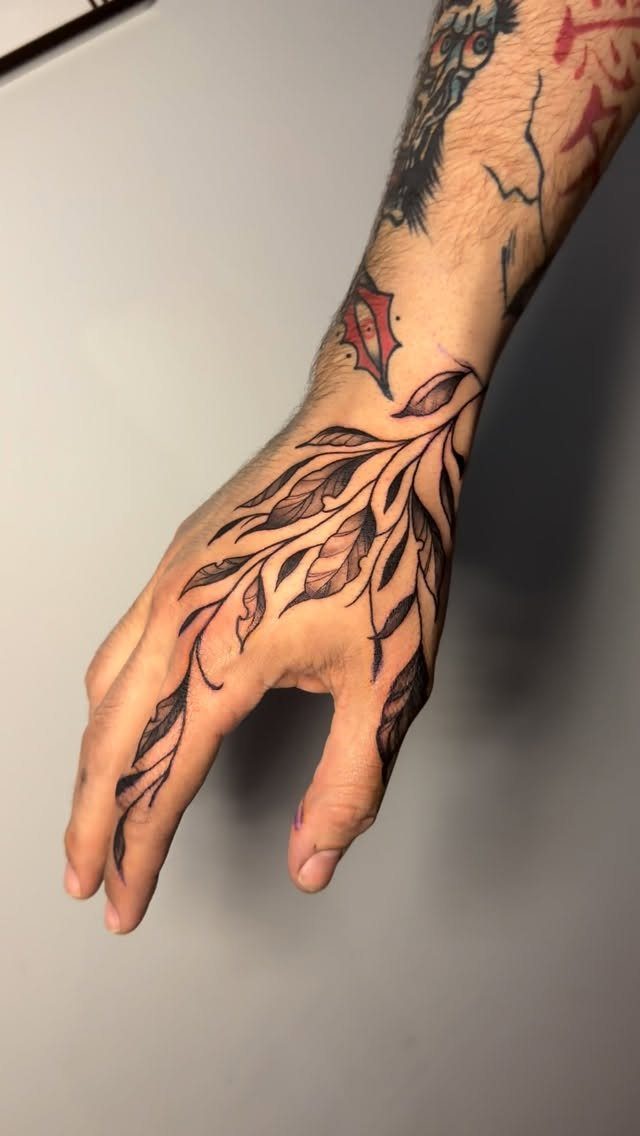
Hand skin turns over fast and holds ink poorly; what reads crisp on the forearm goes soft on the knuckles fast.
A vine that flows onto the fingers instead of stamping a solid shape there lets the fade act as texture rather than failure.
A botanical that starts at the forearm and continues past the wrist needs planning for how it crosses the joint.
Leaves that point toward the hand read as movement; leaves that sit perpendicular fight the arm’s length. Most artists charge hand work at a higher rate because of the touch-up likelihood, and some will not tattoo fingers at all.
Check before you book. If your job prohibits visible ink, this placement removes the option of hiding it.

MADE IN THE USA SINCE 1990: For over 30 years Dynamic Color has produced professional tattoo ink in the United States, an established American brand artists built their work on long before most imported labels existed.

MADE IN THE USA SINCE 1990: For over 30 years Dynamic Color has produced professional tattoo ink in the United States, an established American brand artists built their work on long before most imported labels existed.

MADE IN THE USA SINCE 1990: For over 30 years Dynamic Color has produced professional tattoo ink in the United States, an established American brand artists built their work on long before most imported labels existed.
6. Flowing Vine with Leaves and Berries

Vines grow without asking permission, which makes them forgiving for first large pieces; the artist can adjust the curve to your muscle without breaking a symmetrical design.
Keeping the line weight light and letting the berries sit as dots, not solid black, gives the whole thing the feel of ink drawing rather than tattoo.
For your own, consider whether you want one continuous vine or several that start and stop. Continuous reads as bracelet or sleeve, scattered reads as collection.
Berries add rhythm; without them, leaves alone can blur together from a distance. A good vine tattoo steps back to check its read from across the room, not just its detail up close.
Healing on the forearm is straightforward, but the inner arm bruises more and may need an extra week before the line clarity returns.

Made from the highest quality Oracal 651 Vinyl


7. Monstera Leaf Blackwork Tattoo
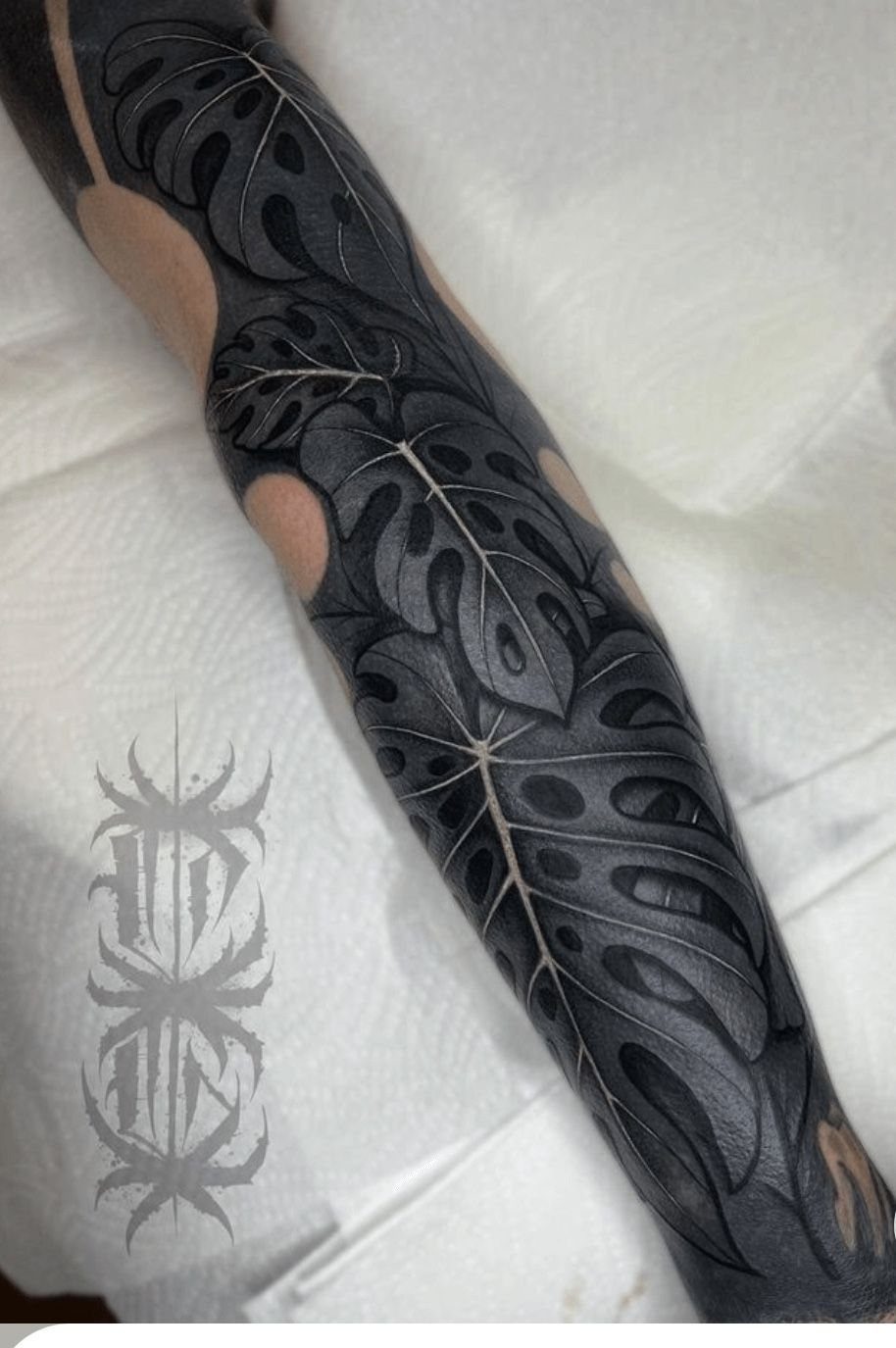
Monstera leaves suit blackwork because their natural venation gives the artist ready-made negative space.
Heavy black fill around those veins stays bold for years where greyscale would soften. The large leaf shape also covers ground fast; a single mature leaf can anchor a forearm piece without the complexity of a multi-flower arrangement.
Ask your artist whether they will cut the veins clean with skin breaks or leave them as un-inked skin.
Skin breaks heal sharper but carry slightly more scarring risk; un-inked skin is safer but can close unevenly. Either way, the leaf’s natural split edges let the tattoo end organically at the wrist or elbow without a hard border.

LARGE SIZE AND MORE QUANTITY -- Total 77 Sheets Temporary Tattoo Stickers for Men and Women Adults Including 17 Sheets Large Size (7.48*3.74 inches) and 60 Sheets Small Size (3.85*2.28 inches), The large size can cover more arm area and the small size can show your personality moreSize

Product Includes: You will get 8 sheets of lace temporary tattoos, meet most of your needs

Features a classic American traditional tattoo style illustration of a formidable shark paired with a vintage-inspired scroll banner for bold, artistic look. Unique Stipple Art Detail: Detailed stippling and dot-work shading art.
8. Snake Entwined with Botanicals
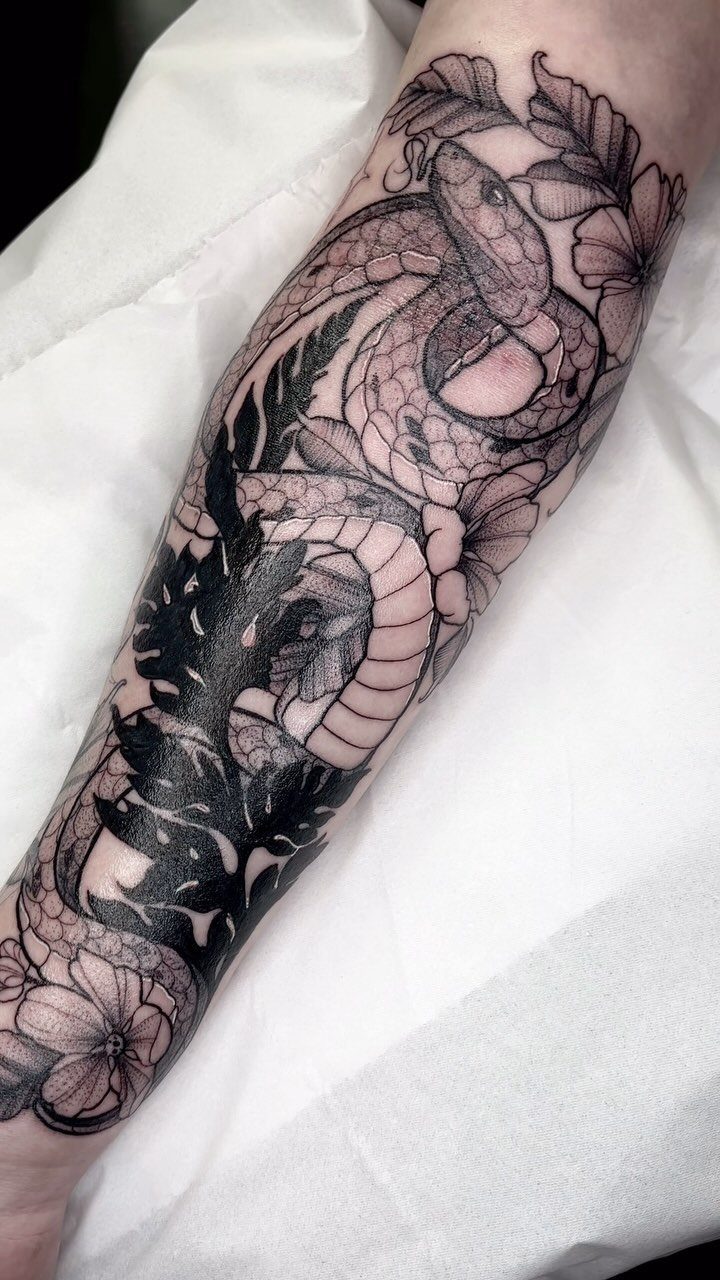
A snake threading through stems gives movement that a static bouquet cannot.
The body curves over and under, creating depth with nothing but line weight; where the snake passes behind a leaf, a slightly lighter black or stippled edge sells the overlap.
This matters because blackwork lives on clarity, and overlap without that shift reads as flat pattern.
The snake’s scale texture needs fine dotwork or tight hatching that will blur faster than the broader botanical shapes around it. Plan touch-up money once the piece starts to fade, especially if it sits on the forearm.
Some artists run the snake’s head toward the hand for forward motion, others coil it back toward the body; either works, but the direction should feel intentional, not arbitrary.

1203RL FOR DEFINED FINE LINES – #12 0.35mm three-needle Round Liner configuration delivers a defined fine-line setup for lettering, detailed outlines and small tattoo designs.
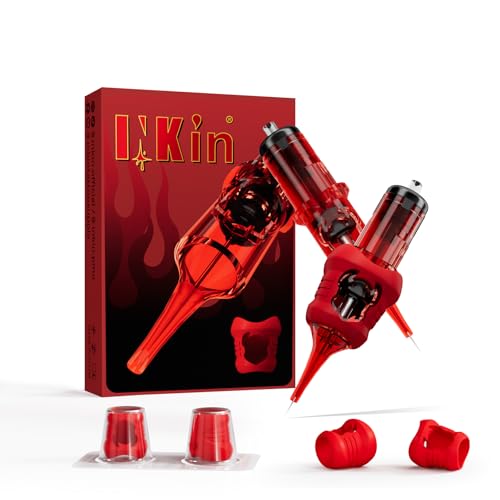
Upgraded Silicone Grip: INKin as one of the earliest brands focusing on tattoo finger ledge cartridges, upgraded design with high-grade TPE material, EL Diablo tattoo cartridges include 8 pcs optional grips, allowing tattoo artists to customize grip based on individual preferences, giving a comfortable, anti-slip grip reduces vibration and hand strain for long sessions.
Package includes 10 pieces of each size: 3RL, 5RL, 7RL, 9RL, 3RS, 5RS, 7RS, 9RS, 5M1, 7M1
Tattoo Styles and Techniques
Fine line, solid black, and dark gothic approaches each demand different needle setups and healing behavior.
Dark gothic work builds from woodcut and crosshatch traditions where carved blacks and sudden skin breaks create the drama; the line weight carries the piece, and wobbles show immediately because there is no soft grey to hide them.
Tattoo styles and techniques vary widely in blackwork botanicals, and which approach an artist defaults to for botanicals—plus whether they adjust technique for the specific flower or leaf structure you are after—is worth asking before the needle touches skin.

24PCS Unique Henna Stencil Pack – This complete henna tattoo kit accessory set includes 24 sheets of reusable mehndi stencils (6.89" x 3.34"). Featuring exclusive designs like long arm bands, moon motifs, vine flowers, and large floral templates, it is ideal for creating DIY temporary skin art on wrists, arms, back, and full body.

Variety Botanical Pattern: This set of hand face painting stencils contains 12 sheets 142+pcs Wildflower Floral tattoo Stencils for daily use, such as wildflower, floral, narrow leaves, plants, Spring flowers, butterfly etc allow children and adult to give full play to their imagination and fill in patterns freely

ELEGANT BOTANICAL VINE ART: Features a graceful, continuous blooming layout mimicking the natural, organic curvature of growing forest flora. This delicate botanical illustration is crafted using a digital hand-drawn fine line tattoo ensures crisp lines to deliver ultra-sharp leaf silhouettes, intricate wildflower clusters, and clean minimalist stem line weights.
Placement Ideas
Arms and forearms dominate botanical placement for good reason. The cylindrical shape lets vertical compositions flow naturally, and the muscle curve gives large leaves or dense arrangements a natural pedestal at the shoulder or elbow.
A vine that continues past the wrist needs deliberate planning for how leaves angle across the joint; foliage pointing toward the hand reads as growth, while perpendicular leaves fight the arm’s length.
Budget and session planning also shift by placement: a sleeve needs multiple sittings spread across months, while a single forearm leaf can finish in one.

100% brand new and high quality

Triple Blackout Tattoo Ink - Strengthen your shading with Triple Blackout, the boldest black designed for greater dimension in your tattoos. With a glycerin free formulation, this professional tattoo ink inserts smoothly into the skin for excellent distribution and shading.
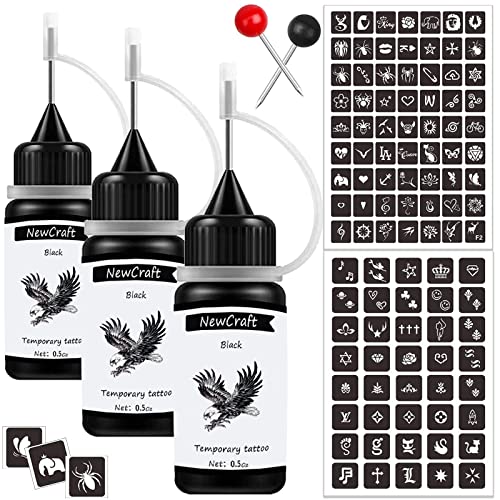
PACKAGE CONTENTS: There are 3 packs black temporary tattoo ink, 103 patterns tattoo stencils and one pin included in this comprehensive kit
Tattoo Artist Recommendations
Botanical blackwork demands an artist who understands how specific plant structures translate to skin.
Dense fern arrangements and high-contrast leaf compositions require confident line placement and controlled stippling; not every blackwork specialist has spent time studying how venation patterns or petal overlap read at tattoo scale.
When reviewing portfolios, look for healed photos, not just fresh work. Black ink settles and lightens; an artist who only shows day-of images may not be tracking how their fine lines or solid fills age.
For dark gothic or thorned vine pieces, check whether their crosshatching stays clean in healed work or blurs into indistinct grey.
Some artists excel at the bold graphic side of botanicals but struggle with the delicate negative space that makes a monstera leaf or magnolia cup read correctly.
The right match depends on which botanical language you want: etching-influenced, woodcut-heavy, or fine-line restrained.