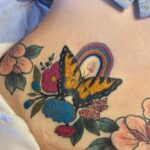
The outer thigh takes the same needle depth heavier than the shin does, and an artist used to arms will often shrink mandala patterns down too small for thigh placement.
1. Polynesian Leg Sleeve Tattoo

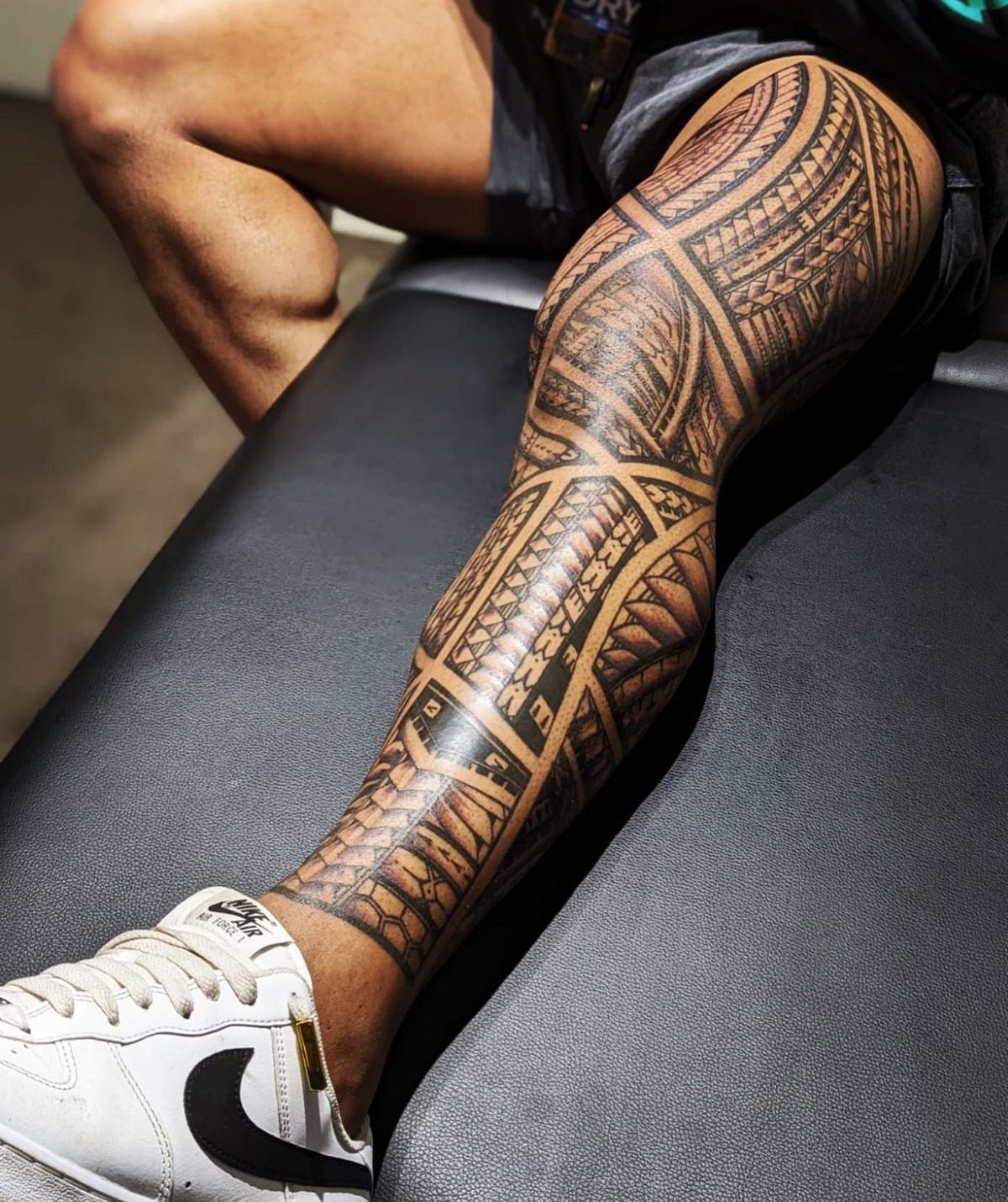
Polynesian tribal work reads differently on a leg than on an arm because the muscle groups are longer and the skin stretches more with every step.
A sleeve that runs thigh to ankle, or thigh to toes on one leg paired with a calf piece on the other, uses that vertical space for repeating shield and spearhead motifs that draw the eye upward.
The black-and-grey shading in traditional Polynesian style is built from hand-tapped or machine-stippled patterns; either way, the artist needs room to let negative space breathe between dense black sections.
Budget for multiple sessions, since rushing the fill-in leaves muddy edges where the design should read crisp from across a room.
This is a commitment piece: it suits someone who wants the leg to look like carved wood or stone, not a canvas for scattered images.
Leg tattoo artwork from full leg sleeves to standalone thigh and calf pieces. Explore Japanese leg sleeves, realistic portraits, nature themes, and ornamental leg designs.
— Tattoodo

Tattoo Designs: This set includes 12 distinctive tribal tattoo stencils, featuring unique Maori, Polynesian and Samoan ethnic motifs, as well as classic tribal patterns, allowing you to create unique works of art

✔[TOTEM TRIBAL SLEEVE TATTOO] Briyhose Tribal Totem Temporary Sleeve Tattoos Can Cover Your Body Parts Large. It Contains 4 Sheets 18.9 * 6.7 Inch (48 * 17cm) Realistic Viking Tribal Long Full Sleeve Temporary Tattoos And 4 Sheets 8.3* 5.8 Inch (21 * 14.8cm) Hawaiian Turtle Half Sleeve Fake Tattoo Stickers For Adults Men Women Tatto Kit. You Can Share It With Your Family And Friends.
2. Naruto Anime Leg Sleeve Tattoo

Anime characters need color saturation to read as intended, and Naruto’s orange-and-black palette holds up better on calf-to-thigh placement than on spots that sun-bleach fastest.
The black and red ink visible in the reference still carries that energy; red replaces orange in some versions for bolder contrast against skin tones.
A leg sleeve gives the artist enough vertical real estate to stage a narrative moment, not just a portrait, which is why thigh-to-knee framing works well for a running or fighting pose.
Anime shading has hard edges that heal unevenly if the skin gets overworked in one go; this piece almost always needs multiple sittings.
Plan for several sessions with healing time between, since dense color packing stresses the skin more than outline work.
This suits a reader who already knows which arc or jutsu they want referenced; vague anime nostalgia usually ends in a cover-up.

Warm Tips: The tattoo transfer paper need to work with transfer medias.You will need to purchase the stencil ointment separately. Apply the design made on the master paper. Please pay attention to press the back side of the pattern to the skin for at least 3 seconds
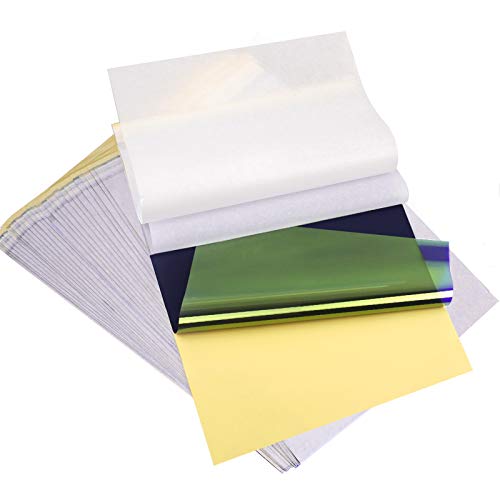
ADVANCED MATERIAL: Tattoo transfer paper is made with the high quality dyes and stencil paper. Transfer marks are very clear, clean and smooth. Tattoo transfer paper kit come with 35 sheets. Great for tattooing, trace and transfer images onto the body.<br>

Precision Transfer Performance - It’s professional-grade tattoo stencil paper delivers vibrant, high-definition transfers even for intricate designs. The carbon layer ensures sharp outlines without smudging or fading, ensuring crisp lines that stay true to your original artwork.
3. Geometric Leg Sleeve Tattoo
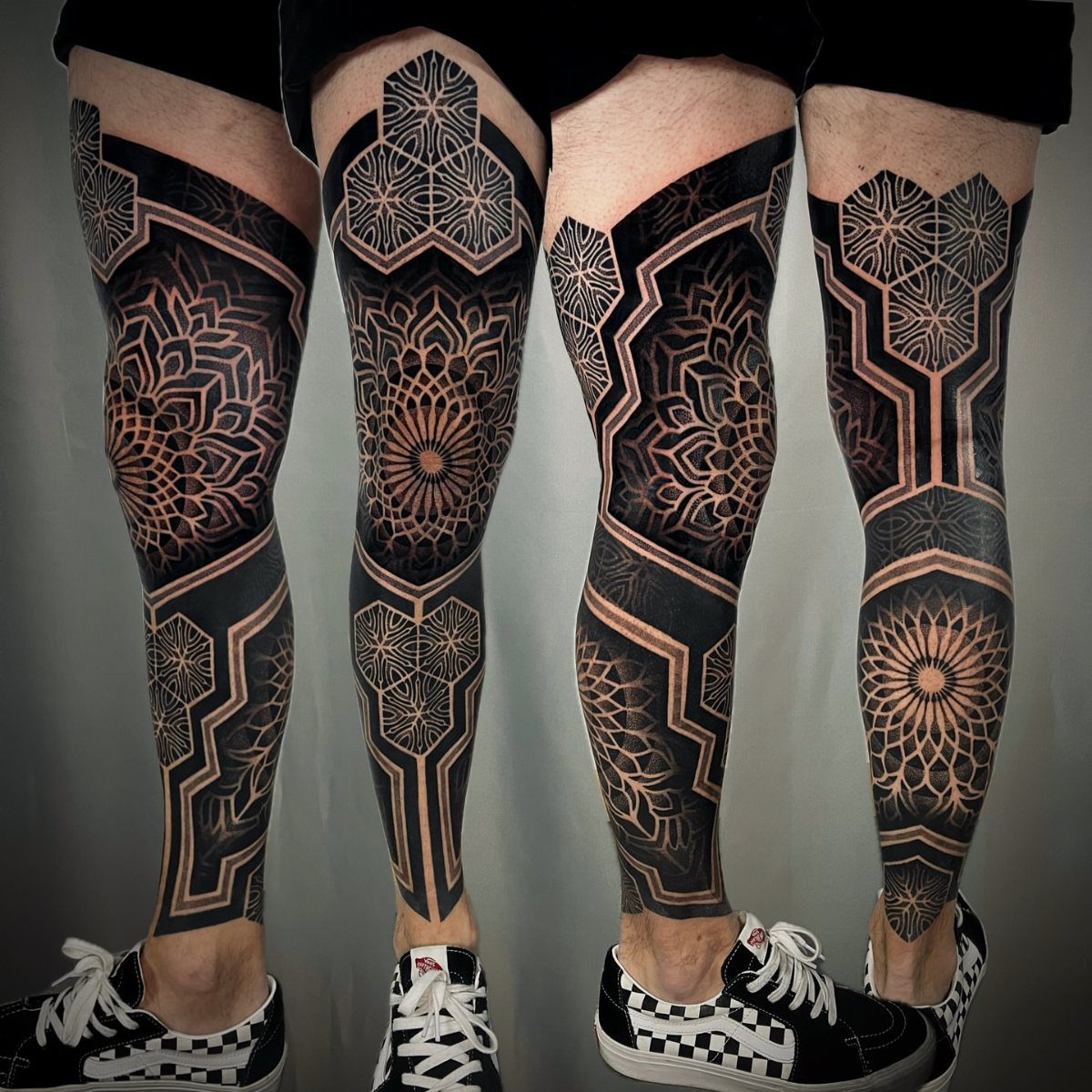
Honeycomb grids and mandala centers turn the leg into an optical instrument, especially when the design breaks at the knee and resumes with a shifted scale below it.
The thigh-to-below-knee span in the reference creates that mesmerizing jump by using blackout sections as rest stops between fine-line lattices.
Blackwork this dense demands an artist who understands how ink settles differently on the outer thigh versus the shin; the same needle depth reads lighter where the skin is thinner.
Budget serious time for the initial pass, with touch-ups likely as the solid black settles over the first year. This is for someone who wants the leg to look engineered, not illustrated; it trades away narrative content for pure structure.

High-quality material: These honeycomb spray painting templates are made of high-quality PET material, which is strong and reliable, not easy to break and tear, comfortable and soft, with a smooth surface, not easy to fade, reusable and waterproof, easy to clean, suitable for your long-term use.

Create Professional Airbrush Designs: elevate your custom paint projects on cars, motorcycles, and helmets with our PVC airbrush stencils; Whether you are a hobbyist or a professional, these stencils allow you to create stunning, intricate patterns with ease, delivering a high-end custom look to any vehicle

Package Includes:16pcs different texture stencils for painting.Perfect for adding an artistic background to your projects.Every reusable geometric stencil for painting is 6x6inch.
4. Ancient Egypt-inspired Leg Sleeve Tattoo

Pharaoh profiles, scarab beetles, and Anubis on the lower leg give a full sleeve enough specific icons that the eye keeps finding new detail from different angles. Black-and-grey treatment keeps hieroglyphs readable at a distance, which color sometimes muddies.
A leg sleeve suits this subject because Egyptian art was already designed to be read in registers, horizontal bands that stack vertically; the thigh becomes the upper register, the ankle the lower.
The artist needs to know the difference between authentic hieroglyphs and decorative squiggles, since a misplaced symbol is a permanent error, not a typo.
This works best for someone with a genuine interest in the culture, not just a vague pharaoh aesthetic; the research phase should take longer than the tattooing.

Package: 50pcs mixed tattoo cartridge needles, includes 10pcs each of 1203RL, 1205RL, 1207RL, 1209RL, 1211RL.

Mast Pro purple tattoo cartridges needles have been providing with high density clear plastic body.
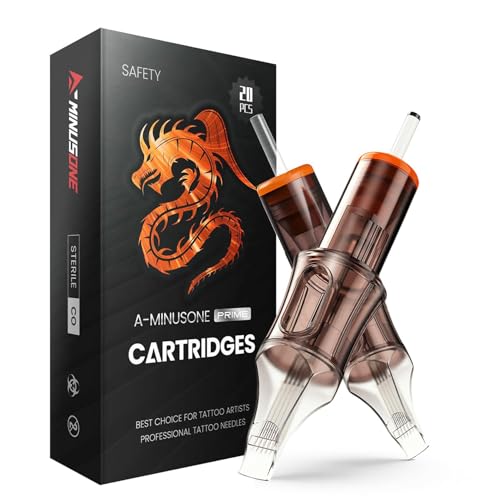
Complete Package: 20 pcs 1215RM tattoo cartridge needles for Liner. Achieve various types of tattoo designs with these 1215RM standard cartridge needles.
5. Japanese Style Leg Sleeve

A samurai helmet, mask, and tiger in full color follow the irezumi tradition of pairing warrior gear with natural forces that test or protect the wearer.
The leg sleeve format lets the tiger climb from ankle to thigh, muscles seeming to flex with the calf beneath the skin.
Traditional Japanese work uses specific color rules: the tiger’s stripes are usually black or dark grey, the fur golden or orange, the background waves and clouds in blue-grey washes.
A pagoda variation focused on the calf-to-ankle area works as an alternative if the full leg feels overwhelming.
Either way, find an artist who has studied under someone trained in Japanese methods; the background filler techniques are not intuitive and show immediately when done wrong.
This is the most technically demanding entry on this list, and the one most likely to need 15 to 20 hours across six months.

✔[FULL SLEEVE TRIBAL TATTOO] Briyhose Tribal Full Arm Temporary Sleeve Tattoos Can Cover Your Body Parts Large. It Contains 4 Sheets 18.9 * 6.7 Inch (48 * 17cm) Long Sleeves Totem Tribal Fake Tattoo Stickers For Adults Men Women Tatto Kit. You Can Share It With Your Family And Friends.


✔[TRIBAL TOTEM TEMPORARY TATTOO] Briyhose Totem Tribal Temporary Tattoos Can Cover Your Body Parts Large. It Contains 8 Sheets 8.27 * 5.83 Inch (21 * 14.8cm) Realistic Tribal Fake Tattoo Stickers For Adults Men Women Tatto Kit. You Can Share It With Your Family And Friends.
6. Floral and Mandala Leg Sleeve

Large roses and peonies paired with mandala centers turn the leg into a garden plan viewed from above, the mandalas reading as formal beds and the flowers as natural growth between them.
The hip-to-ankle span in the reference uses the body’s longest uninterrupted skin surface for a single composition that never feels crowded.
Black ink only keeps the linework crisp for decades; color in floral work tends to shift warm over time, which can make pink peonies read as orange.
The mandala patterns need to be scaled to the muscle underneath or they distort when the leg moves; an artist who works mostly on arms will often make them too small for thigh placement.
This suits the reader who wants decoration that reads feminine without being delicate, and who has the patience for a project that spans multiple weekends.

Precision Transfers & Long Lasting: Tattoo stencil paper delivers vibrant, high-definition transfers even for intricate designs. Creates crisp, dark lines that transfer cleanly to skin (clearly on different skin tones) which are easy to follow during tattooing. The carbon layer made from high-quality dyes ensures sharp outlines without smudging or fading and maintains crisp lines visibility throughout long tattoo sessions, so you can focus on creating art instead of re-drawing lines

Premium Quality Thermal Paper: 100 continuous feet of Thermal Paper ensures uninterrupted tattoo stencil creation. Cut to any desired length, maximizing efficiency and minimizing waste.

4-layer Design: The 4-layer design ensures a crisp, clean transfer with sharp lines and fine details. Each layer has a specific function — such as holding the stencil ink, releasing it evenly, and protecting the tattoo paper during storage — which minimizes smudging, prevents distortion, and makes application easier on different skin surfaces.
7. Tiger and Ornamental Leg Sleeve
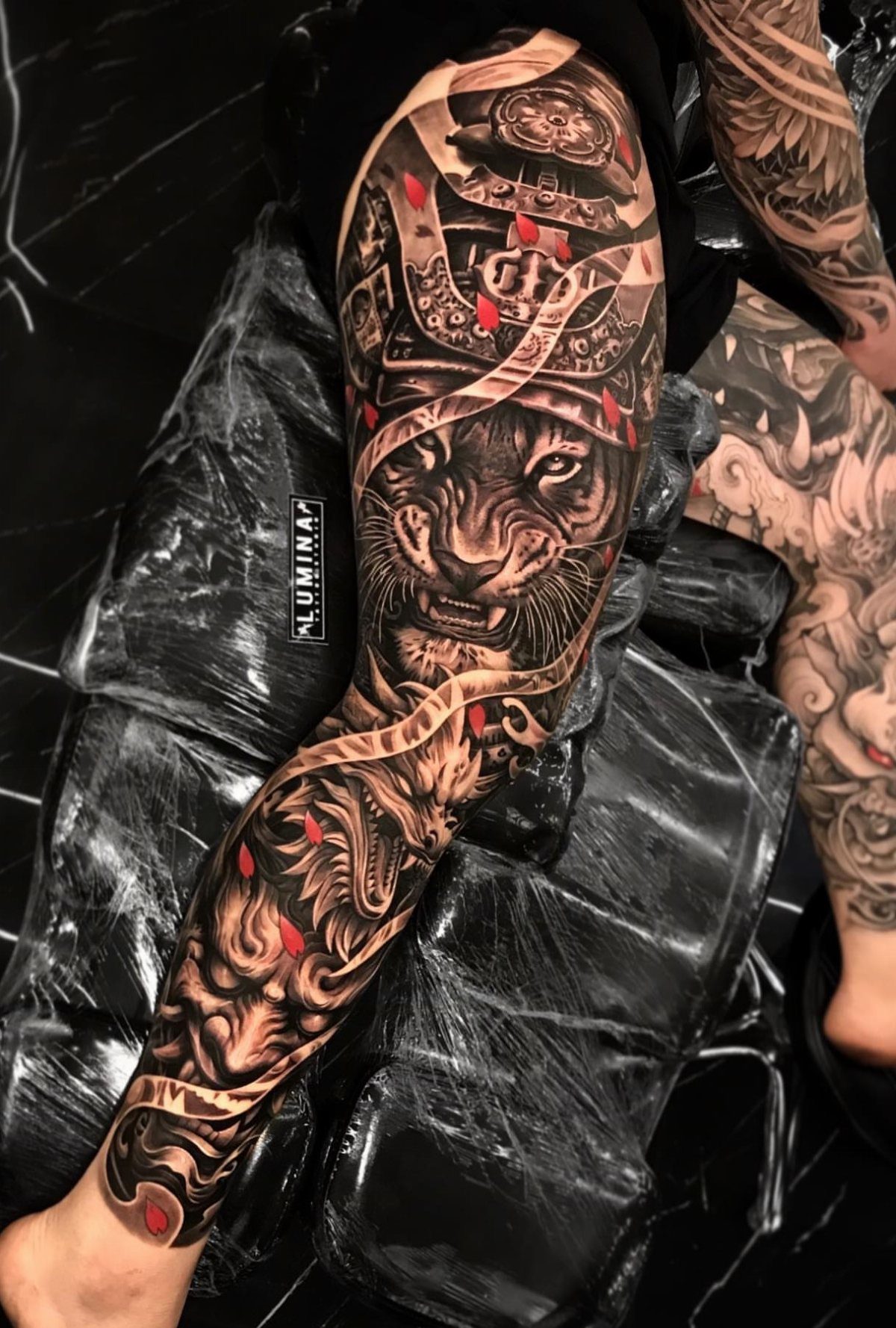
A snarling tiger face in black and grey, ringed by ornamental scrollwork, turns the leg into a carved object rather than a painted one.
The lack of color puts all the weight on needle technique: the artist has to build fur texture from whip-shading and stippling alone, since there is no orange or black ink to do the reading for them.
Ornamental frames around the tiger keep the eye moving so the portrait does not sit isolated; the scrollwork should flow with the muscle, not fight it.
This is the choice for someone who wants the drama of a predator piece without the maintenance that color demands; black and grey heals cleaner and ages slower on a part of the body that sees sun and friction.
Find an artist whose portfolio shows both realism and decorative linework; one without the other leaves the tiger looking pasted on.

Package Comes with: you will receive 1 piece reusable painting stencil, which is A4 size 8.3 x 11.7 inches / 21 x 29.7 cm

Package Content: You will get 10 pieces honeycomb bee stencils with 10 different honeycomb size options, and provided 2 sizes of the stencil, the large stencil is measure 11.8x11.8 inch, the small stencil is measure 5.9x5.9 inch!

HONEYCOMB STENCIL: Include 1pc honeycomb stencil templates, creamy white, size is 11.81"x11.81", larger size templates are more convenient to use
Pain Tolerance Considerations
The back of the knee and the shinbone sit right on nerve bundles and thin skin, which is why a full leg sleeve rarely happens in one marathon session.
Most artists break it into 3 to 5 hour blocks, not because they are slow, but because the body stops cooperating after that.
The thigh has more padding and handles needles better; the ankle and foot are a different story, and some artists will not tattoo below the sock line in the same sitting as the calf.
Numbing creams exist, but many artists refuse them because they change how the skin reacts and can lead to overworking an area.
If you are unsure about your tolerance, start with a calf piece or the outer thigh, both of which sit over muscle rather than bone. A leg sleeve is a long project; pacing it correctly matters more than bravery.

Mast Pro purple tattoo cartridges needles have been providing with high density clear plastic body.
Mast Pro purple tattoo cartridges needles have been providing with high density clear plastic body.

⭐Tattoo needles are made of 316L surgical stainless steel and medical-grade plastic. The highest quality material is healthy and durable enough to work.
Temporary Vs. Permanent Tattoos
Temporary leg sleeves let you test how a full design reads against your actual muscle shape before committing to 20 hours of needlework.
A quality transfer or henna application buys you enough time to test placement; friction from jeans kills the ankle faster than the thigh.
The real value is seeing whether you want the design vertical, whether it needs to break at the knee, and whether you are willing to shave the leg regularly for visibility.
Some shops now offer cosmetic tattoos that fade naturally after several days; these cost more but show how the line weight holds at different scales.
If you are deciding between a Polynesian tribal pattern and a geometric grid, wearing each for a week reveals what you stop noticing and what you keep looking at. That information is worth more than any consultation photo.

DESIGN VARIETY: Select from 2 packs which include multiple Polynesian-inspired designs featuring sea turtles with tribal patterns, hibiscus flowers, and traditional sun motifs in black and metallic gold

4 x Sheets of different Tribal Hawaiian Tattoo is Temporary Tattoo Transfer Paper Body Art Sticker

Historical Significance of Tattoos
In ancient Egypt and Rome, leg tattoos marked social status directly; in Samoa, surviving the leg tattooing process was itself the proof of status, since the pain was public and the result permanent.
Japanese irezumi, which evolved into the Yakuza body suits, started as legitimate markers of identity before the 20th century associations took hold.
The shift from social signal to personal belief is recent; even a few decades ago, American leg sleeves were mostly military or biker territory, not the mixed-style canvases common now.
What has not changed is the body part: the leg remains a space where the commitment is visible but controllable, coverable for work and displayable on personal terms.
That practical history, more than any ancient symbolism, explains why the leg sleeve format keeps growing across styles that share nothing else culturally.

🔍 Precision Industry-Standard Transfer - Engineered 4-ply stencil paper (8.25"x11.75") with high-density dyes delivers defined lines for intricate tattoo stencils. Compatible with major thermal printers for reliable tattoo transfer paper workflows.


🔥 4-Layer Professional Precision : Achieve ultra-sharp tattoo stencils with Yuelong’s 4-layer system (white master + carbon layer + protective tissue + yellow backing)! Delivers smudge-free transfers for intricate designs—ideal for tattoo artists demanding accuracy on every line.